
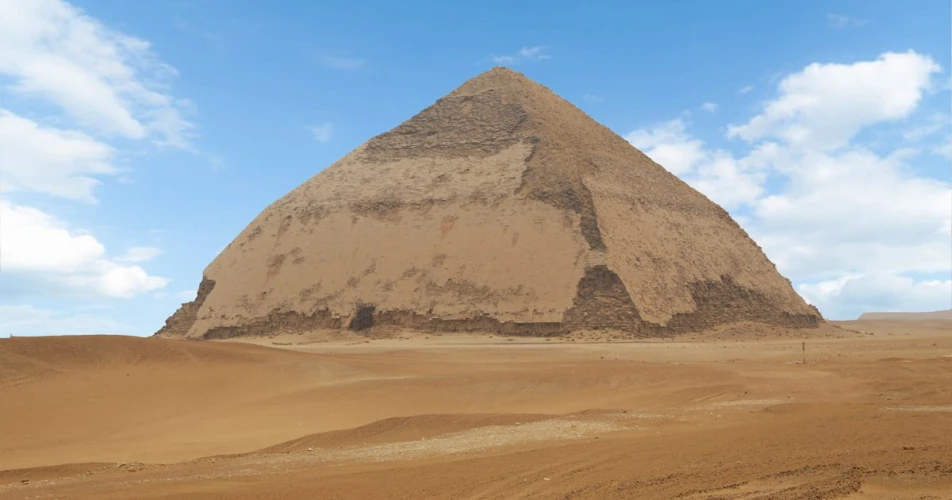
Visiting the Bent Pyramid of Dahshur: History, Architecture, and Travel Tips
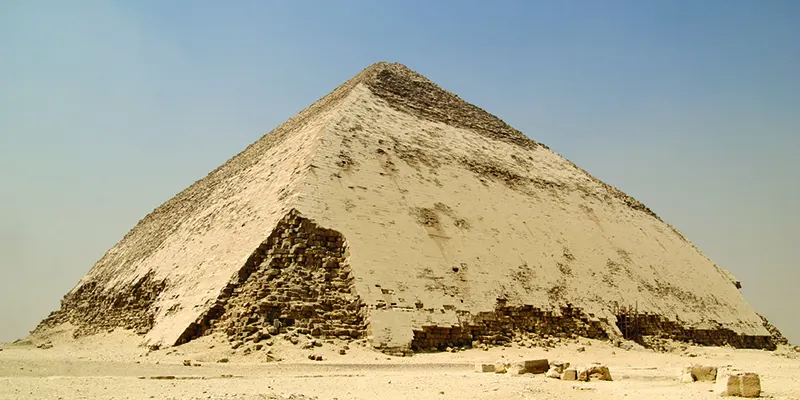
The Beautiful Mistake: Why Egypt's Bent Pyramid is the Key to the Pyramids
When we picture the ancient monuments of Egypt , our minds tend to slide right toward the Giza Plateau . We kind of imagine the Great Pyramid of Khufu , standing there like a geometric miracle with those straight, rising slopes that just cut into the blue sky . It feels so light and flawless that it has spawned plenty of theories about how that kind of precision could be achieved .
Still, architectural perfection is never made overnight. It comes from trial, error , impatience , and constant adaptation .
To understand where the ancient Egyptians really learned how to build a true smooth sided pyramid , you have to step away from Giza and head about 40 kilometers (25 miles) south to the quieter desert royal necropolis of Dahshur .
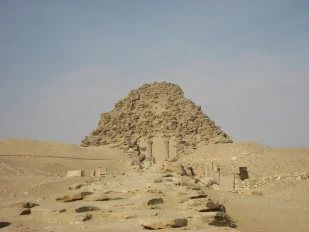
Rising alone from the sand is a structure that looks absolutely singular, a bit awkward, and honestly kind of irresistible: The Bent Pyramid.
Constructed during the reign of Pharaoh Sneferu (the father of Khufu) around 2600 BCE, this monument is, in a sense, a literal transition locked in stone. It is a tangible record of ancient builders testing the limits of physics and structural engineering as they went along . So let’s dive into the tale of this beautiful mistake, its remarkable preservation, and why it may be regarded as the most important pyramid in Egypt .
1. The Design: Why is it Bent?
When King Sneferu’s royal builders set out to construct his grand tomb at Dahshur, they weren’t trying to create that bent kind of form, no. Their aim was more like building the world’s very first true, smooth-sided pyramid, you know, not those weird stacked things. Before this, royal tombs were mostly “Step Pyramids” (like the Step Pyramid of Djoser in Saqqara), which looked more or less like stacked stone benches or awkward terraces.
So the architects kicked things off with a steep, bold slope of 54 degrees. It sounds confident, and honestly it probably was, at the start.
But as the pyramid rose, higher and higher into the sky, the sheer weight of the limestone blocks began to press outward with serious force. On top of that, the internal chambers weren’t exactly sitting on rock—underneath was soft, shaky clay-like ground, so everything had that “too unstable” vibe. Pretty soon, the walls inside the corridors started to crack and shift, under this terrifying load.
Then, realizing the whole monument was basically hanging by a thread, the builders made this dramatic, split-second call while they were still in the middle of construction. They added a massive stone girdle around the base, to stabilize the foundation. And at the same time, they reduced the angle of the upper part, down to a much safer 43 degrees.
That mid-project pivot is what created the unique double-angled silhouette we see today, with that awkward-heroic bend. It’s basically a compromise with gravity—one of those brilliant saves, that kept the thing from failing completely, and somehow turned it into the monument’s legendary “bent” look.
2. The Best-Preserved Casing Stones in Egypt
Even if the Bent Pyramid’s overall form may have been a kind of misstep, the craftsmanship behind it was, somehow, wonderfully superior.
Now when you check out the Great Pyramid of Giza today, you mostly see that rough inner heart—the core blocks. Meanwhile the sleek, polished outer limestone casing, those pale facing stones, got basically stripped down over the centuries by builders in the medieval period, who reused the material for mosques, and palaces all through Cairo.
The Bent Pyramid though… it’s this big, noticeable exception.
Thanks to the special lean of its sides , and the fact that the workers set the casing stones at a slight inward slant instead of flatly horizontal, the outside layer has stayed stuck to the core for more than 4,600 years. It still keeps the greatest share of intact, original polished limestone facing of any pyramid found in Egypt.
So if you stand at the bottom and tilt your gaze upward, you can really take in those smooth wide sheets of gold-tinged white limestone, and it feels like a rare, direct glance at how these gigantic monuments actually looked when they were freshly finished.
3. Descending the Deep: Inside the Bent Pyramid
For decades, the inside of the Bent Pyramid was more or less off limits to normal visitors, because safety worries plus that shaky kind of story around it. But lately, the Egyptian government kind of swung open its deeper rooms, letting more adventurous travelers step in.
Going into the Bent Pyramid feels way more rugged, more bodily, than walking into the Great Pyramid of Giza,
Two entrances , which is oddly specific: the Bent Pyramid has two separate entry points—one on the north side, and another on the west side. Each one leads you into its own self contained set of internal chambers, and only later were the two systems linked by a rough, hand cut passage.
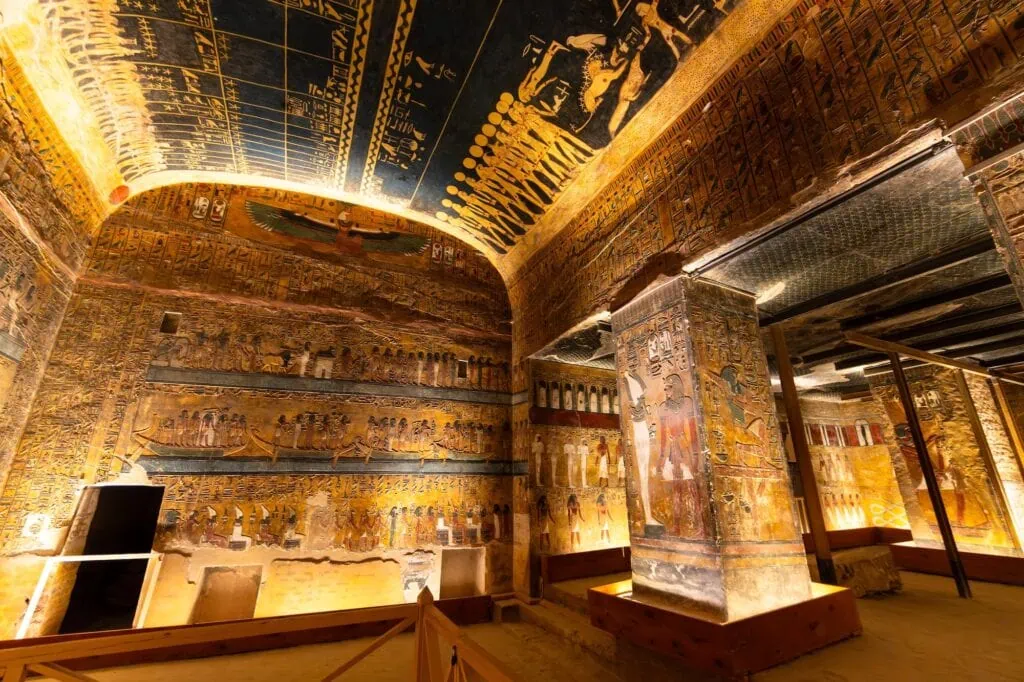
The northern shaft , so to speak: most people enter through the north passage, where you climb down along a steep, tight, low ceilinged wooden ramp. It drops more than 79 meters , about 260 feet straight into the cold core of the stone.
The cedar beams: once you’re in the main burial chamber, under that high corbelled ceiling, you can look upward and spot the original Lebanese cedar wood beams set in place by Sneferu’s builders—thousands of years back—mainly to hold up the shifting walls. The air inside is dry and very low in oxygen, so the wood has stayed preserved really well. You can still make out that ancient grain.
4. Dahshur vs. Giza: The Travel Experience
So if you’re thinking about going to Egypt, visiting Dahshur feels like it’s in a different world, a calmer sort of stop than those loud crowd moments you get at Giza.
Since Dahshur sits just a bit off the usual main tour bus track, you end up out there, more or less on your own, with the desert breeze doing its thing, and you’re looking up at the Bent Pyramid with not another soul showing up. It’s kind of deep and meditative, like quiet reflection, and it ties you straight back to the very ancient past.
5. Security for High-Adventure Bookings
Since Dahshur sits a little more to the south, most travelers end up booking a private day tour, with one dedicated air-conditioned vehicle and an Egyptologist guide, to tie together the Bent Pyramid and the neighboring Red Pyramid. Sneferu apparently, built that Red Pyramid right after the Bent one, and yes, they use the corrected 43-degree angle from the beginning!
When you arrange these private custom excursions before you even arrive, make sure the tour operator runs payments via certified, very secure checkout platforms like WeTravel or payment gateways backed by Stripe.
These options use the industry-standard PCI-DSS Level 1 encryption to securely tokenize your card details. In practice it means your financial information stays concealed from outside sales staff, so you can pay deposits safely and map out your Egyptian adventure with genuine peace of mind.




-webp.webp "Hilton")
-webp.webp "dusit")
-webp.webp "Marriott Hotels")
-webp.webp "Azimut Hotel")
-webp.webp "Golden Tulip")
-webp.webp "sheraton")
-webp.webp "westin hotel")
-webp.webp "Movenpick")