
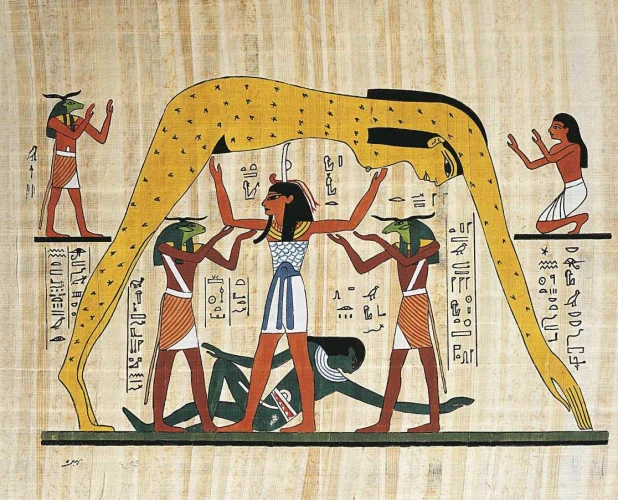
The Legend of the Sky: How Nut Formed the Stars
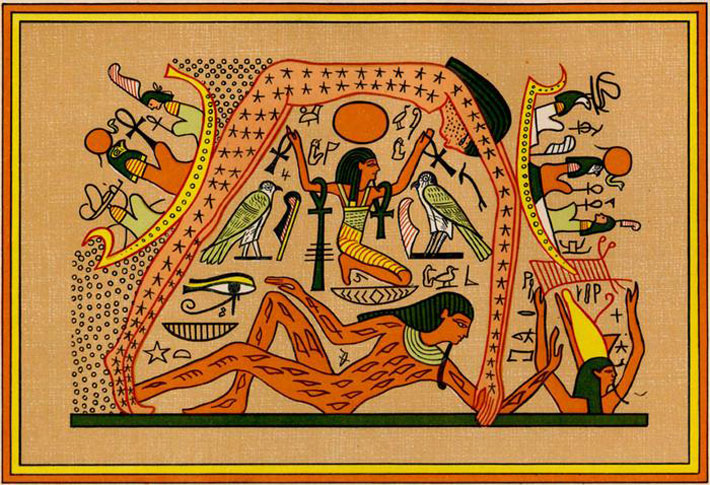
To stand in a temple in Upper Egypt after dark in 2026 is to realize that the ancient Egyptians didn’t just look at the stars—they looked through them. To them, the night sky wasn't a vacuum of cold space; it was a living, breathing woman named Nut.
She is the goddess of the sky, the mother of the stars, and the ultimate protector of the soul. Her story is one of the most romantic, tragic, and scientifically poetic legends in human history. If you’ve ever looked up at the Milky Way and felt a sense of cosmic "embrace," you are feeling what the Egyptians felt 4,000 years ago.
1. The Primal Embrace: Geb and Nut
In the beginning, before the world had "depth," there was only a tight, eternal embrace. Geb (the Earth) and Nut (the Sky) were twins and lovers, locked so closely together that there was no room for air, light, or life to exist between them.
-
The Problem of Chaos: In this state of "primordial hugging," nothing could grow. There was no horizon, no seasons, and no space for humanity.
-
The Divine Separation: Their grandfather, the creator god Ra, realized the world could not function in this darkness. He commanded their father, Shu (the God of Air), to step between them.
-
The Human Image: If you visit the Temple of Dendera in 2026, you will see this moment carved into the ceilings: Shu standing with his arms raised, pushing Nut upward into an arch while Geb lies beneath her, stretched out across the ground. This "Great Divorce" created the world as we know it.
2. The Thoth Loophole: How the Stars Were Born
Ra was so angered by the bond between Geb and Nut that he placed a curse on her: “Nut shall not give birth on any day of any year.” At that time, the Egyptian calendar had exactly 360 days.
-
The Gamble of Wisdom: Nut, desperate to bring her children into the world, turned to Thoth, the ibis-headed god of wisdom. Thoth challenged the Moon (Khonsu) to a game of board games (Senet).
-
Winning the Light: Thoth won enough moonlight to create five extra days—days that didn't belong to any month and weren't part of Ra’s original calendar.
-
The Five Children: On these "demon-days" (the Epagomenal days), Nut finally gave birth to the five great deities: Osiris, Isis, Set, Nephthys, and Horus the Elder.
-
The Milky Way Connection: In 2026, astronomers have confirmed that the ancient depictions of Nut's body arched over the earth align perfectly with the position of the Milky Way during the summer solstice. The "stars" on her skin weren't just dots; they were the souls of her children and the light of the galaxy itself.
3. The Daily Cycle: Swallowing the Sun
The Egyptians believed that Nut was the reason for the sunrise and sunset. This wasn't just a metaphor; it was a biological cycle of the cosmos.
-
Sunset (The Swallowing): Every evening, as the sun reached the horizon, it entered Nut’s mouth. Throughout the night, the sun traveled through her body—a journey through the "Duat" (the underworld).
-
Dawn (The Rebirth): Every morning, Nut gave birth to the sun once more, its red glow representing the blood of birth.
-
The Human Truth: This cycle taught the Egyptians that death was not a "stop," but a transition. Just as the sun passed through Nut to be reborn, the human soul would pass through the sky to be rejuvenated.
4. Nut as the Protector of the Dead
Because Nut "contained" the stars and the sun, she became the ultimate guardian for those who had passed away.
-
The Sarcophagus Lid: If you look at the inside of a stone sarcophagus lid in the Valley of the Kings (particularly KV2 or KV6), you will see Nut looking down at the mummy.
-
The Mother’s Embrace: She is painted there so that the deceased is never "in the dark." To be in a coffin was to be inside the body of the Sky Mother. A common prayer from 2026 BCE (which still resonates in 2026 AD) says: “O my Mother Nut, stretch yourself over me, that I may be placed among the imperishable stars.”
5. Where to Find Nut in 2026
If you are traveling the Nile this season, these are the three places where the "Legend of the Sky" comes alive:
| Location | What to Look For | The "Human" Vibe |
| Temple of Dendera | The "Zodiac" and Nut ceilings. | The most vibrant blue you will ever see. |
| Tomb of Ramesses VI (KV9) | The "Book of Day" and "Book of Night." | Nut arches across the entire ceiling, twice. |
| The GEM (Cairo) | Nut-painted sarcophagi. | A chance to see her "face-to-face" at eye level. |
6. The "Human" Wisdom of the Nut Myth
Why does a story about a sky goddess matter in the modern age? Because the Legend of Nut addresses the three great human anxieties: Space, Time, and Death.
-
Space: The myth of Shu separating Geb and Nut reminds us that we need "air" and "room" to grow. Sometimes, even the most loving embrace can be stifling.
-
Time: The Thoth "loophole" reminds us that there is always a way to find time for what we love, even when the "calendar" says it's impossible.
-
Death: The image of Nut swallowing the sun reminds us that every ending is simply the beginning of a journey through the dark toward a new dawn.
7. A 2026 Stargazing
When you are on your Nile cruise, ask the crew to turn off the deck lights for 15 minutes while you are sailing between Luxor and Aswan.
Look up. You will see the Milky Way—the "river of stars"—stretching from one horizon to the other. In that moment, don't think about "light years" or "gas giants." Think about Nut. Think about her arching over you, her hands touching the East and her feet touching the West, keeping the chaos of the deep universe at bay so that you can breathe the cool Nile air in peace.




-webp.webp "Hilton")
-webp.webp "dusit")
-webp.webp "Marriott Hotels")
-webp.webp "Azimut Hotel")
-webp.webp "Golden Tulip")
-webp.webp "sheraton")
-webp.webp "westin hotel")
-webp.webp "Movenpick")