
-webp.webp)
The God Who Walks the Earth: Decoding the Divinity of the Pharaoh
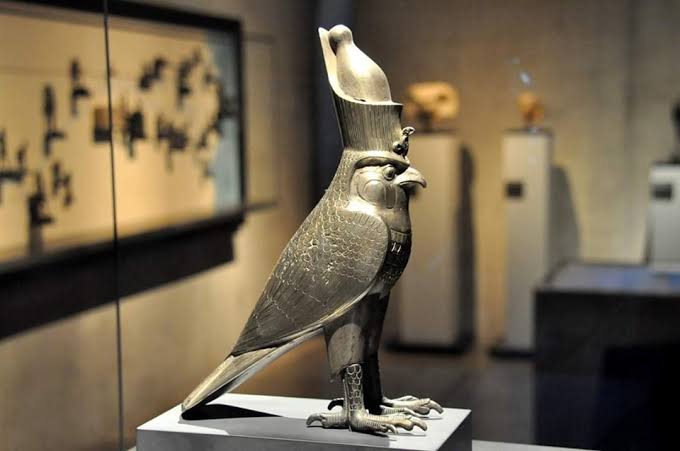
A person who stands before you at this moment exists in your time because he shares your human qualities of breathing and speaking and aging. His presence alters the atmospheric conditions which surround him. The Nile people consider this individual to be more than a political leader and military commander because he represents the Living Horus. He serves as the central point where human existence connects with divine reality.
People in 2026 view ancient "god-kings" as an intelligent deception which rulers used to maintain authority through intimidation and mystical beliefs. Egyptians considered this practice to be fundamental because it served as their essential psychological and spiritual requirement. The Pharaoh functioned as the sole protector who maintained civilization's elegance against the wild destruction which originated from the desert.
The "God Who Walks the Earth" story describes how human beings experience burden of entire universe. The story shows how the falcon uses its wings to shield the royal throne.
1. The Two-Fold Nature: Man and Manifestation
The most interesting aspect of Egyptian kingship shows that people possessed sight when they understood that Pharaohs existed as human beings. People watched him eat and they watched him worry until they finally saw him die. The question arises how he could be considered a deity.
The Royal Ka: Egyptians believed that royal authority possessed a divine spirit which they called the Royal Ka and this spirit would move from one ruler to another. When a prince was crowned, he "put on" the mantle of Horus.
The Living Mask: The sacred mask functions like a The man who wears it maintains his human identity but he assumes the divine role. The "Living Horus" performed actions which did not belong to him because he acted as the god who preserved the world's balance (Ma'at).
The Human Burden: The responsibility of following proper rituals every day created a burden which forced people to stay awake all night. The "God-King" transforms into a person who must perform heavy responsibilities instead of enjoying wealthy life.
2. Why Horus? The Myth of the Falcon
To understand why the King was specifically linked to Horus, we have to go back to the most famous family drama in history: the struggle between Horus and his uncle, Set.
The Legitimate Heir: After the murder of Osiris, Horus fought a long and brutal war to reclaim his father’s throne. Every Pharaoh who identified with Horus declared "I am the rightful heir. I have defeated chaos, and I have restored order."
The Protector of the Sky: Horus was a sky god who used his eyes to represent the sun and the moon. The Pharaoh became the "Living Horus" because people believed he controlled the sky.
The Falcon’s Embrace: The Diorite statue of Khafre contains one of the most famous statues in history because it shows a small falcon that perches behind the King's head while its wings circle his neck. The carving presents one of the most "human" representations of divinity because it shows the god as a protective partner who remains silent instead of being a faraway master.
3. The Life Cycle of a God: From Horus to Osiris
Pharaohs were considered divine but their status as gods changed throughout the year according to seasonal patterns and celestial movements.
The Living King (Horus): The King existed as a fierce protective falcon throughout his lifetime. As "Lord of the Two Lands" he watched over the nation while keeping its borders secure.
The Deceased King (Osiris): After his death a Pharaoh would experience a sacred transition. He stopped being Horus and became Osiris who ruled the Underworld.
The New Sunrise:His son became the new King who took on the duties of Living Horus. The royal transition process maintained continuous royal presence because it ensured constant divine illumination from the throne. The system achieved complete success in maintaining national stability which lasted for three thousand years.
4. Recharging the God-Power: The Sed Festival
Even a god-king gets tired. The Egyptians organized a large Heb-Sed celebration to maintain the Pharaoh's divine status.
The Marathon of Divinity: After 30 years on the throne, the King had to prove he still had the "Horus-energy." The king would run a ritual race through a defined track to show his physical strength and spiritual power.
The Renewal: If he succeeded, he was "re-crowned" and symbolically reborn. The people used this event to observe their "God Who Walks the Earth" remaining suitable for his leadership role. The event functioned as an ancient "state of the union" address which carried greater importance than regular affairs.
5. The Falcon in the Modern World (2026)
The 2026 connection to Horus still holds significance for us today.
Humans throughout history have searched for extraordinary leaders who would help them navigate uncertain times according to their naming of leadership roles as Kings Presidents and CEOs. The Pharaoh was the ultimate version of this.
The Egyptians understood that their King existed as an integral part of the natural world. The King maintained health which directly affected the Nile River's condition. The experience brings back memories of a past time when we were strongly connected to nature which we now strive to restore.
6. The Artistic Identity: The Horus Name
Every Pharaoh had five different names, but the most important one was the Horus Name. The name was displayed inside a rectangular frame which served as a Serekh that depicted the palace facade with a falcon standing on top.
The Symbolic Branding: This was the King’s "official" identity. The sign declared that "the falcon resides within this palace." The sign functioned as both an identification marker and a security alert that announced an impending danger to the Egyptian people who would be safeguarded by divine protection.



-webp.webp "Hilton")
-webp.webp "dusit")
-webp.webp "Marriott Hotels")
-webp.webp "Azimut Hotel")
-webp.webp "Golden Tulip")
-webp.webp "sheraton")
-webp.webp "westin hotel")
-webp.webp "Movenpick")