
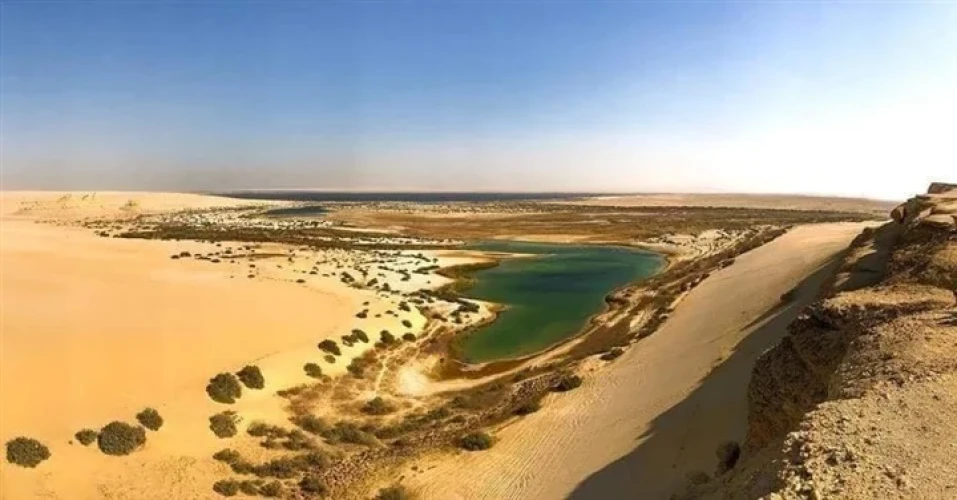
The Evolution of Identity: Tracing Faiyum’s Name Through the Ages
.jpg)
The Western Desert contains a location which maintains its existence according to different rules than those governing all other sandy areas. The Nile River supplies water to create a vibrant green area which exists as a leaf-shaped indentation that extends through the limestone plateau. This place exists as Faiyum.
Faiyum 2026 presents itself as an ideal location to discover authentic connections between humans and natural elements which include water and earth. The word "Faiyum" is a living fossil. The word functions as a linguistic connection which has maintained its existence through five thousand years of various empires and religious transformations and language development. The evolution of this name allows one to understand how a community developed their identity from turning a natural lake into their own urban paradise.
1. The Primordial Root: Pa-Yom (The Sea)
The initial Egyptians who came down from the high desert areas into the low land area discovered an inland sea which they regarded as both an oasis and a city. At this site a massive inland sea existed which represented the ancient Lake Moeris. The ancient Lake Moeris functioned as a significant water body which extended its perimeter beyond its current boundaries.
The ancient Greeks named this body of water as Pa-Yom which contains the definite article "the" and the term yom which means "sea" or "large body of water". The Human Perception: To them, it wasn't just a pond; it was a vast, unpredictable force of nature. The name "The Sea" served to identify the water body because its power required recognition. The desert country uses its enormous blue water body as the most powerful representation of life.
The 2026 Connection: Think about how we name things today—"The Coast," "The Valley," "The City." The basic elements of our language help us to establish complete locations which shape our everyday existence. Ancient people considered the "Sea" to be the most important location in their world.
2. Shedet: The Land "Drawn Out" of the Water
The name of the region began to change when the population increased and the Middle Kingdom Pharaohs Amenemhat and Senusret discovered its agricultural capacity.
The Reclamation: They constructed an extensive network of dams and canals to manage the Nile river water entering their territory. The process created agricultural land which resulted from transforming specific lake regions.
The Name: The capital city was named Shedet which comes from a root meaning "to draw out" or "to reclaim."
The Identity Shift: This represents the first major "humanized" shift in identity. The people began to engineer land reclamation which allowed them to remove the "The Sea" from their ancestral territory. Faiyum became a symbol of human ingenuity.
3. The City of the Crocodile: Crocodilopolis
The Greeks perceived Faiyum as a different place than what they had encountered when they entered Egypt shortly after Alexander the Great's conquest. The sacred crocodiles which rested on the lake's muddy banks represented their god Sobek according to their beliefs.
The Greek Interpretation: The city received the name Crocodilopolis which means City of the Crocodile. The Ptolemies later changed the name to Arsinoe in honor of a beloved queen but the local residents maintained their bond to the aquatic life and waterways of the area.
Faiyum became one of the most culturally diverse locations in the world during this time period. Greek veterans and Egyptian farmers and Jewish merchants all shared the same living space. The name of the region began to carry the weight of a sophisticated, cosmopolitan identity.
4. From Coptic to Arabic: The Birth of Al-Faiyum
The pronunciation of the ancient Pa-Yom underwent gradual transformation throughout the centuries between the decline of Hieroglyphs and the introduction of Coptic script.
In the Coptic language which represents the final stage of the ancient Egyptian language The Sea became Phiom or Peiom. The sound which changed its pronunciation still maintained the same meaning throughout both forms of understanding.
The Arabic Integration: The Arab conquest reached Egypt during the 7th century when new arrivals first heard locals calling the lush province "Phiom." The name received its protection through Arabic definite article "Al" which the original name received as a supplement to its existing Arabic definite article.
Al-Phiom underwent transformation into Al-Faiyum through a process of linguistic evolution. The location retains its original name because conquerors introduced new terms which only affected its appearance through different languages.
5. The Legend of the Thousand Days: A Humanized Myth
The scholars can easily follow the linguistic route to their research destination, but the Faiyum region shows them its authentic linguistic route. The elders at the waterwheels in the city will share the story of Prophet Joseph (Yusuf) during the year 2026.
According to folk tradition, Joseph established a giant granary in Faiyum because he was given the duty to protect Egypt from famine. The king assigned him "A Thousand Days" (Alf Yom) to finish his miraculous job of lake drainage and canal construction work.
The Reality of Belief: While linguistically unlikely, this myth is "humanly" true. The people believe that their land is a divine miracle which was constructed in record time using divine wisdom. The name "Faiyum" thus carries a double meaning for the locals: the "Sea" of their ancestors and the "Thousand Days" of their faith.
6. The Geographic Soul: Why the Name Matters Today
The name Faiyum serves as a mission statement which describes the region until the year 2026. This governorate represents the only area in Egypt which exists outside of valley zones and true oasis territories because it functions as a sink that consumes Nile water into its boundaries.
The Waterwheels: The Saqiyas represent the famous wooden waterwheels of Faiyum through their existence in the physical world. The mechanism enables water to be transported from the "Sea" to agricultural areas.
Lake Qarun: The lake exists as the remaining water body that represents the former ancient Pa-Yom territory. The lake has reduced its size throughout history yet it still defines the character of the area. Faiyum exists only because the lake continues to exist.
7. The Name as an Anchor
The name Faiyum has changed throughout history as people from different cultures have used it since Pyramid builders spoke it and Greek scholars wrote about it and Coptic monks used it in their prayers and modern Egyptians continue to use it in their daily conversations.
The word "Faiyum" which you pronounce in 2026. You are speaking a 5,000-year-old truth. You are acknowledging "The Sea" that refused to disappear. You are honoring the "Thousand Days" of hard work that it took to make a desert bloom.
The name Faiyum exists in a location where water maintains its historical knowledge. Faiyum exists as an aquatic body or crocodile city or Joseph's miracle which people use to identify it as their everlasting need to establish homes beside water bodies.



-webp.webp "Hilton")
-webp.webp "dusit")
-webp.webp "Marriott Hotels")
-webp.webp "Azimut Hotel")
-webp.webp "Golden Tulip")
-webp.webp "sheraton")
-webp.webp "westin hotel")
-webp.webp "Movenpick")