


-webp.webp)
The Architecture of Eternity: Sacred Sanctuaries and the Birth of the Stone Pyramid
.jpg)
1. The Isolated Sanctuary and Solar Rituals of the Temple Roof
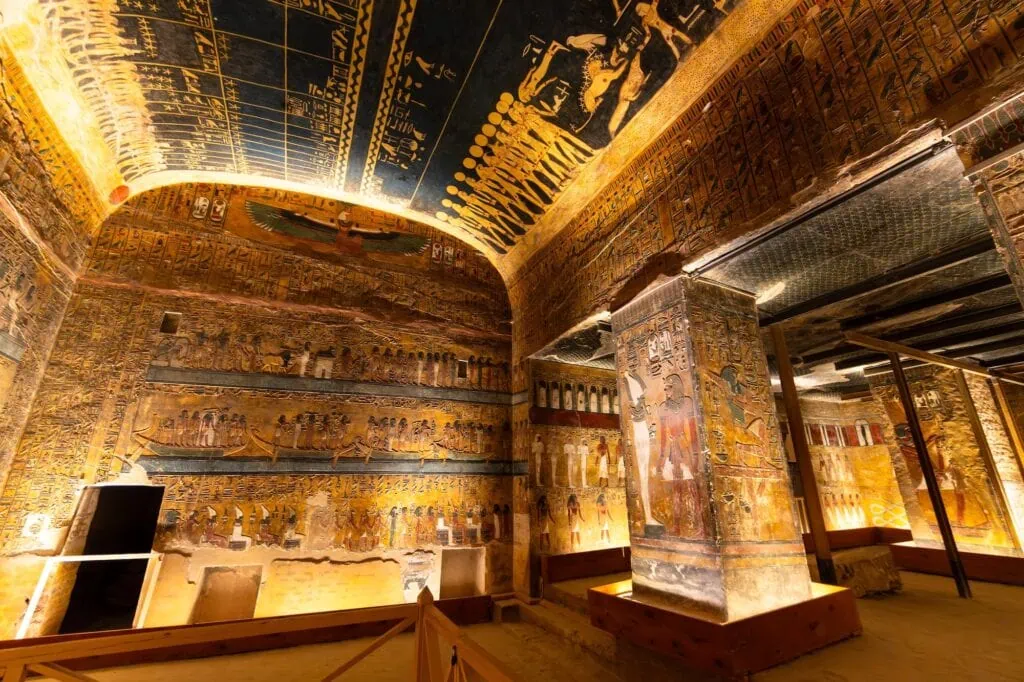
tombs building. To mark the difference between the sacred and the profane areas the sanctuary was isolated as though it was an independent building, a kind of box inside the main structure, with a roof and cavetto cornice distinct from the main roof. In the sanctuary stood the travelling boats of the deities in which they journeyed from temple to temple. Many of the temples had crypts with beautifully carved walls, where much of the best regalia was kept. All temples must have had chapels on their roofs, but they now only survive in the late temples of Dendarah (Rte 34) and Philae (Rte 39) though Denderah was an early foundation whose original building goes back to the Predynastic period. One of these roof chapels was connected with the 'Union with the Disk', when the statues of the gods worshipped were brought up on days such as the New Year Festival, and revitalised by being exposed to the rays of the sun. Other chapels on the roof were connected with the resurrection of Osiris. All temples were surrounded by temenos walls of mud-brick or stone, and within the enclosure lived the priests. There was also a sacred lake or well, and numerous storerooms and there must also have been stabling for the animals. The slaughter court attached to the temple for the killing of the sacrifices was usually entered from the outside. Sculpture was an integral part of the temples. Statues of the kings were made, often of colossal size to stand inside or in a row at the entry. These were thought to guard the entrance and to act as constant intercessors with the gods, as were sphinxes, usually with a human head on a lion's body (see Giza, Rte 23). Tombs.
2. The Birth of the Mastaba: Egypt's Earliest Royal Tombs
Originally the tombs were mere graves cut in the soil or in the sand on the desert escarpment. However, as time went on the desire to preserve the body after death led to tombs of one or more chambers being constructed. The early royal tombs at saqqarah
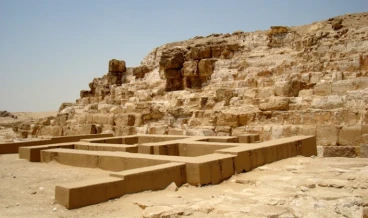
had substruc-tures consisting of several chambers, with the burial chamber at the centre. This was surrounded by store rooms, in which have been found hundreds of stone and pottery vases. They were roofed with timber beams and had a superstructure also consisting of several rooms filled with offerings. Both these and the similar cenotaph-like buildings at Abydos have been burnt, so that it is difficult to see what the full royal collections would have been. These tombs are now called mastabas (Ar. bench) from their similarity to the mud-brick seat found outside most Egyptian peasants' houses. By the 3 Dyn. these mastaba tombs were used also for the burials of nobles and high officials, the superstructure built of stone instead of mud-brick, and the body placed in a chamber at the foot of a shaft leading down from either the courtyard, or from a room containing the false door which usually contained the name and titles of the deceased.
3. Rock-Cut Chapels and the Cities of the Dead
Alternatively the upper class citizens could be buried in rock-cut tombs, as they were in the provinces; again the upper chamber, or chambers, served as a chapel, and the body was placed at the foot of a shaft leading down from one of these rooms. The servants and officials of these nobles were later buried in shaft graves cut near to their masters. In the same way the king's officials and members of his family were buried round the king's pyramid. These were known as mastaba fields or pyramid cities, but they were really cities of the dead.
4. Imhotep’s Revolution: The Step Pyramid and Stone Enclosure
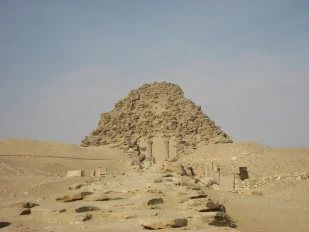
The pyramid was the logical development from the mastaba. The ease with which mastaba tombs were robbed prompted the kings to build larger and heavier structures which the tomb robbers would not be able to enter. This trend had already started by the 2 Dyn. but the first stepped pyramid was not built at saqqarah until the 3 Dyn. this was built to Zozer's order by the chief of works Imhotep and was the first building in Egypt to be constructed entirely in stone. In many ways it is unique, with a large enclosure, the walls representing 'the white walls of Memphis' recessed and buttressed like the facade of the earlier mud-brick mastabas. Within the enclosure was a mortuary temple, but no causeway has been found so that there may not have been a valley temple. Beginning with a mastaba, Imhotep built a stepped pyramid with seven stages, standing at one end of the sacred enclosure. The bulk of the enclosure is empty but there are a large number of religious buildings to the east of Zozer's temple and a vast complex of underground passages terminating in a granite chamber which was the king's burial place. It took the Department of Anti-quities three years to empty the underground galleries of the large number of stone vases. Many of the galleries and the 'Southern Tomb' are lined with blue faience tiles and the pyramid was laced with Lebanese cedar to strengthen it.




-webp.webp "Hilton")
-webp.webp "dusit")
-webp.webp "Marriott Hotels")
-webp.webp "Azimut Hotel")
-webp.webp "Golden Tulip")
-webp.webp "sheraton")
-webp.webp "westin hotel")
-webp.webp "Movenpick")
