
Hermopolis Magna: The Intellectual Capital of Ancient Egypt
.webp)
The governorate of Minya contains a location which emits a powerful ancient ink scent that carries hidden knowledge throughout its surroundings. The site known as El Ashmunein exists under its Greek name Hermopolis Magna. The ancient city of this site functioned as the world’s first legitimate research institution during that time period. The location served as Thoth's residence who functioned as the god of writing and science and magic. The location served as the site where ancient scientists believed authorities created all physical elements of reality.
The year 2026 requires us to examine Artificial Intelligence ethics while we deal with an unending stream of data which Hermopolis provides as a human-centered foundation. Our quest for knowledge needs to be understood as something which humans have pursued throughout history. Humans have investigated celestial bodies and maintained documentation and attempted to interpret the "Sacred Language" which governs existence for thousands of years.
1. The City of the Eight: The Birth of Everything
The Egyptians called this place Khmunu which means The Town of the Eight.
The Ogdoad The people of Hermopolis worshipped eight original gods before Osiris and Isis became their main deities. The three gods represented the chaotic forces which existed throughout the universe. The three gods represented three different forms of cosmic chaos which included infinite space and dark space and hidden space and the space of water.
The Cosmic Egg According to legend these eight deities established a "Primeval Mound" in the marshes of Hermopolis where they laid a cosmic egg. The sun first appeared when that egg developed into a hatchling.
The Human Meaning The creation myth did not provide a frightening experience because it established an early scientific method which showed how order develops from chaotic conditions. The Tasians and Badarians concentrated on their essential needs while the people of Hermopolis studied the process of creation.
2. Thoth: The Divine Librarian and the Human Mind
The position of eternal CEO Thoth governed Hermopolis when it served as the capital city. Thoth functioned as the divine scribe who took the form of either an Ibis or a Baboon. He created the system for recording information which people now use to "know" things.
The Inventor of Hieroglyphs Thoth was credited with giving humanity the gift of writing. The Egyptians considered writing to be a more than just a tax collection method because they believed it enabled them to create living entities through their written words.
The Master of Time: He functioned as the year calculator and moon cycle administrator. He established seasonal progress and maintained cosmic equilibrium through Ma'at.
The 2026 Reflection: People tend to overlook their ability to read and write because it appears to be a basic skill. Scribes in Hermopolis held the highest position of respect among all citizens. The dedication to truth and accuracy needed "humanized" dedication. The ruins which you now see represent the location where writing first originated.
3. The Colossal Baboons: Guardians of Knowledge
The two enormous quartzite baboon statues stand as the most impressive attraction in El Ashmunein today. The statues of ancient Egyptian artistry show more strength than elegance through their heavy and powerful design elements.
A Symbol of Wisdom: The baboon was associated with Thoth because of the way these animals "greet" the sun at dawn with loud cries—seen by the ancients as a morning prayer to the light of knowledge.
The Scale of Thought: The statues from Amenhotep III's reign reach a height of more than 4.5 meters. The "Sentinels of the Library" functioned as guardians who protected the entrance to the Great Temple.
The Tactile Experience: The people of 2026 will use their hands to explore the cool speckled stone surface of these baboon statues. The statement demonstrates that all "abstract" concepts which include philosophy and science require a tangible physical base to exist.
4. Where Hermes Met Thoth: The Fusion of Cultures
When Alexander the Great arrived in Egypt, a fascinating "intellectual merger" happened at El Ashmunein. The Greeks considered Thoth as their own god Hermes who served as a messenger and guardian of boundaries.
The city of Hermopolis Magna received its new name as "The Great City of Hermes." This was a rare moment in history where two cultures didn't fight over whose god was better; they simply combined them into Hermes Trismegistus (Hermes the Thrice-Great).
The Hermetic Tradition: This fusion gave birth to "Hermeticism" which combines Egyptian magic with Greek philosophy to create a system that impacted people ranging from Leonardo da Vinci to Isaac Newton.
The Cosmopolitan Pulse: Hermopolis became a university town because it attracted scholars from all over the Mediterranean who came to study Ancient Wisdom about Egyptian culture which created a major intellectual center of diverse human thought.
5. The Forgotten Basilica: A Layer of Christian History
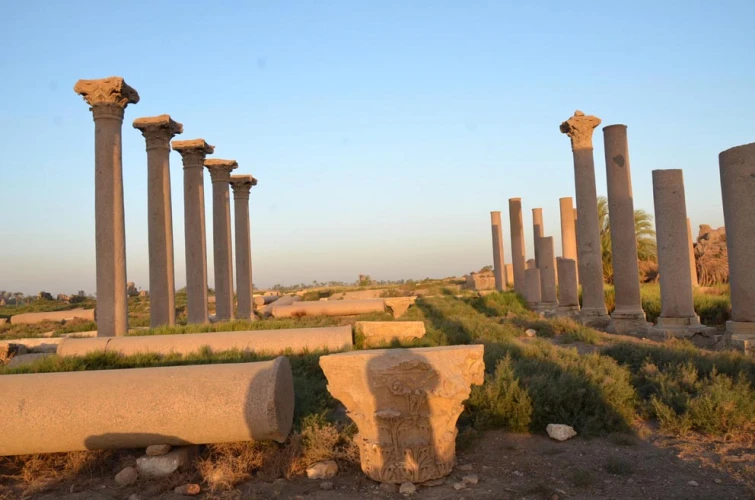
The city of El Ashmunein maintained its significance after the Pharaohs lost their power because it functioned as a critical hub during the Coptic period and its enormous Roman Basilica ruins still exist today.
The basilica was built using repurposed columns from the earlier Ptolemaic temples which created a design that connects to the past through its standing Corinthian columns which create an experience of walking through a stone forest.
The "gods" of the sacred site maintain their "sacredness" because the name changes. The scroll of Thoth lost its function as the main source of higher knowledge when people started using Church scriptures.
The site presents an educational experience about historical recycling through its architectural design. The people didn't destroy their historical heritage because they inhabited their ancient environment while using traditional knowledge to build their contemporary society.
6. Why Hermopolis Matters in 2026
We live in an age of "Information Overload," but El Ashmunein teaches us about "Information Integrity."
The Scribe’s Ethics: Thoth judged the Hall of Truth. He recorded the weighing of the heart. This shows that knowledge without moral values becomes a hazardous force.
El Ashmunein offers peacefulness which contrasts with the active atmosphere of Minya streets. It serves as a space for deep thought. In 2026, we need places that encourage us to put down our phones and simply think.
The Intellectual Ancestry: Every time you write a line of code, draft a letter, or solve a math problem, you are practicing a craft that was perfected in the scriptoriums of Hermopolis.
7. The Library of the Soul
The site of El Ashmunein contains more than its shattered stones and baboon sculptures. The site serves as a testament to human intellect. The site demonstrates that ancient Egyptian intellectual capital existed because people believed that universal order existed and humans could comprehend it.
When you visit El Ashmunein in 2026, don't just look for "photo ops." The sound of reed pen contact with papyrus needs to be heard by you. The "Eight" who created existence will show you their burden. The City of Thoth will remain intact as long as people continue to inquire about "Why?" and "How?"



-webp.webp "Hilton")
-webp.webp "dusit")
-webp.webp "Marriott Hotels")
-webp.webp "Azimut Hotel")
-webp.webp "Golden Tulip")
-webp.webp "sheraton")
-webp.webp "westin hotel")
-webp.webp "Movenpick")