
-webp.webp)
From Mud Shrines to Proto-Doric Columns: The Stone Legacy of Ancient Egypt
.jpg)
From Mud and Reeds to Stone: The Foundations of Egyptian Style
Architecture The early Egyptian builders used the materials closest to hand, mud and reeds, and as the climate was almost ralllless the early settlers needed only lean-to shelters to protect them against the wind winter and the sun in summer. Thus wattle and daub, used even today in parts of Egypt for walls of yards and shelters in fields, was the basis of Egyptian architecture, and this material influenced all later buildings. Another example is the interlaced palm fronds of the lattice which when tied together formed a waving coping to the wall, producing a characteristic shape which, when translated into stone, became the frieze called kheker, to be seen in many of the royal and private tomb-chapels. Wood has always been scarce and the larger timber has always had to be imported. None of the very early buildings has survived but there is a contemporary clay model of a Naqada II house showing it to be of lattice and mud, and many representations of 1 Dyn. shrines made of the same material have been found at Abydos. The latter, which seem to have been of a more open latticework pattern, formed the basis for the shrines of Upper and Lower Egypt, the national sanctuaries used throughout the historic period made in many different materials.
The Birth of the Column: Organic Plant Forms Captured in Stone
Reeds proved too pliant to act satisfactorily as supports for later roofs even when coated with mud, and thus the question of suitable supports arose as soon as sizeable houses were constructed. The front of the porch of the houses needed columns which were made by tying together bundles of papyrus stems. These have a triangular section, and. to form a column the Egyptians tied several together, lashing them with cord just below the heads. When these were later copied in stone, an unexpected result was that the architects duplicated everything, including the curve at the top where the original supported the roof: this was the capital. Below this were the lashings in five stylised bands. The base of the pillar bulged, emulating that in the original. The use of the stone column in Egyptian architecture dates to the 3 Dyn., although some of the early columns were engaged.
Geometric and Plant Capitals: Innovation at Saqqara
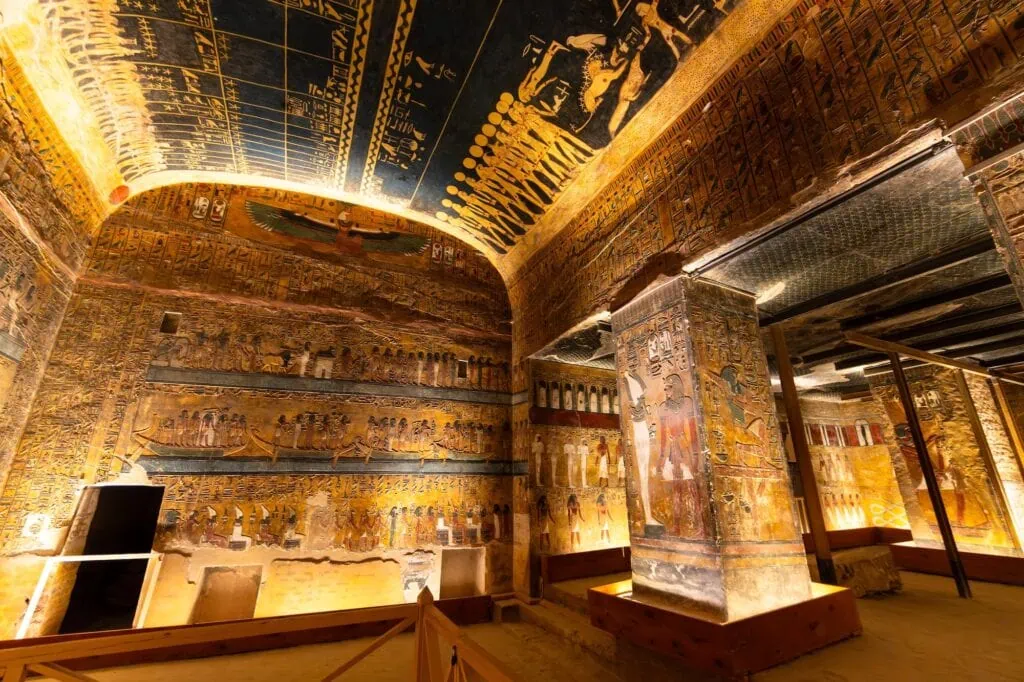
There are two main types of column, both of early origin. The first type, the square-sectioned pillar, probably derived from the supporting sec-tions left in the limestone quarries, and was later used in temples and tombs. The second type of column derives from vegetable forms, such as tied bundles of papyrus or lotus and palm trunks. These are first found in papyrus form at Zozer's Step Pyramid Enclosure at saqqarah (Rte 25), though engaged, as the craftsmen had no idea of the tensile strength of limestone. At this site there are also polygonal ribbed and fluted columns, again engaged in pairs.
The Proto-Doric Evolution: Egypt's Architectural Legacy
The first step towards turning the square pillar or column into the polygonal must have been the cutting off of the angles of the square pillars as seen at Deir al-Bal;lri in the 11 Dyn. Temple of Menthuhotpe (Rte 36). These, and the 12 Dyn. columns at Beni Hassan (Rte 31) and those of Hatshepsut's temple also at Deir al-Bal;lri, were called 'Proto-Doric' by Cham-pollion. Many of the Egyptian columns fldo not taper upwards like the Greek, and they are not all fluted, many having flat facets. Probably 52 ARCHITECTURE both Egyptian and Greek polygonal columns developed indepen-dently from the same prototype, the quarry support, but the former are over two thousand years earlier than the latter.




-webp.webp "Hilton")
-webp.webp "dusit")
-webp.webp "Marriott Hotels")
-webp.webp "Azimut Hotel")
-webp.webp "Golden Tulip")
-webp.webp "sheraton")
-webp.webp "westin hotel")
-webp.webp "Movenpick")