
-webp.webp)
Where the Holy Family Rested: A Journey to the Mountain of the Birds
.webp)
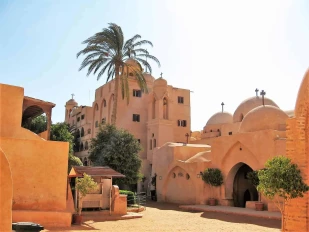
Gabal El-Teir stands on a limestone cliff which overlooks the Nile. The mountain received its name "Mountain of the Birds" because thousands of migratory birds find refuge in its crags every year. The Deir El-Adhra monastery situated on the mountain serves as one of Egypt's most spiritually significant locations.
People search for places which provide "authentic" experiences in 2026, but they end up in areas filled with gift shops and other tourists. Gabal El-Teir stands apart from other places. The photograph shows people who present themselves in their natural state because it shows a moment when their family experienced historical danger. The mountain area creates heavy pressure which interacts with a personal story about surviving through faith.
1. A Holy Stopover: The Flight into Egypt
The heart of Gabal El-Teir exists as a compact and dimly lit cave. According to tradition, the Holy Family which included Mary, Joseph, and the infant Jesus used this location as their resting place during a three-day period of their dangerous escape from King Herod's soldiers.
The Human Connection: Gabal El-Teir shows the Holy Family through icons made of gold and statues carved from marble which create a more human connection to their story. A young mother and her protective father experience complete exhaustion while they carry their newborn through the merciless terrain. The cave existed as a "shrine" at that time; people needed it to survive.
The Miracle of the Palm: Local legend tells of a falling rock that threatened the Holy Family’s boat as they sailed past. Jesus supposedly reached out his tiny hand and stopped the mountain from collapsing, leaving an imprint of his palm in the stone. This gave the mountain its other name: Gabal El-Kaf (The Mountain of the Palm).
The Physical Link: People who touch the cave walls at present time can experience the ancient feeling of relief which existed during past times. The most important historical figures needed to experience basic human feelings which included finding a hidden space to escape.
2. The Monastery of the Pulley: A Vertical History
The monastery's location on a vertical cliff that extends three hundred feet above the river made traditional accessibility methods unusable for reaching the site.
The Box and the Rope: The site received its nickname Deir El-Bakra (The Monastery of the Pulley) because of this site feature. Visitors and supplies used to reach the site by climbing the cliff through a wooden box system that operated with a windlass and rope until modern roadways were established through the rock.
A Test of Faith: Imagine being a medieval pilgrim, trusting your life to a hemp rope and a wooden crate just to reach the church at the top. The monastery used its upward structure to protect itself against attacks while maintaining its original 4th-century building design which exists today in better condition than most Egyptian historical sites.
The current church building exists because Empress Helena, the mother of Constantine the Great, constructed it in the year 328 AD. The church stands as one of the oldest churches worldwide, and its "pulley" history creates a time capsule effect which has been suspended beyond the reach of time for centuries.
3. The Church Carved in Stone
The Church of the Virgin showcases architectural beauty through its design which eliminates unnecessary elements. The structure was built into the mountain instead of being constructed on top of the mountain.
The church contains a main central pathway which runs between two sides of the building and supports twelve large stone pillars which originate from the mountain rock itself instead of quarries. The 12 apostles exist as a permanent unchanging representation through their standing presence.
The altar position directly beside the original cave entrance. The church space which has been constructed transitions into the natural cave system through a process which shows visitors that nature created its most sacred areas.
The interior space maintains a cool temperature which carries the strong scent of beeswax and incense from past centuries. The year 2026 maintains a complete absence of both air conditioning sounds and neon light emissions. The tiny openings in the building permit natural light entry which creates a visual effect of dust particles floating in the air while making the ancient stone appear to exhale.
4. The Moulid: A Mountain of Humanity
The monastery operates as a silent space throughout most of the year except for the period when the Moulid festival of the Virgin Mary takes place in May and June.
A Shared Heritage: Hundreds of thousands of Christian and Muslim pilgrims arrive at the mountain. They camp in tents, share meals, and celebrate the "Mother of the Light."
The 100% Human Celebration: The event creates loud sounds and displays vibrant colors while attracting numerous people. The sites exist for archeologists to study yet they function as essential components of Egyptian identity. The mountain literally vibrates with the sound of thousands of voices which produce a human heartbeat that echoes against the limestone.
5. Why It Matters in 2026
The Gabal El-Teir site provides visitors with a unique experience of "analog" travel which exists outside the modern world that uses "fast travel" together with digital filters. The View from the Edge: Standing on the cliff’s edge and looking out over the Nile is a "humanizing" experience. The experience makes you understand your smallness while you see all the beautiful things in existence.
The Holy Family's journey to Gabal El-Teir tells the story of refugee movements throughout history. The ancient mountain stands as a testament to the enduring practice of offering protection to outsiders which people have regarded as one of their most sacred obligations.
The Guardian of Middle Egypt
The church of Gabal El-Teir which exists on a hill functions as a protective sentinel. The structure has protected the Nile for two millennia after it began serving as a secure site that sheltered frightened people and now functions as a protective area for travelers who need rest.
The site offers visitors more than 4th-century stonework and an ancient legend about a stone handprint. The story shows how people develop strength through their personal challenges which include family struggles and community difficulties whose members needed help from ropes and a faith that stands strong like a mountain.
The "Miracle of the Palm" and the sight of thousands of birds circling the cliffs at sunset both lead Gabal El-Teir to show that our deepest strengths develop through the challenges we face.



-webp.webp "Hilton")
-webp.webp "dusit")
-webp.webp "Marriott Hotels")
-webp.webp "Azimut Hotel")
-webp.webp "Golden Tulip")
-webp.webp "sheraton")
-webp.webp "westin hotel")
-webp.webp "Movenpick")