


Visiting the Colossi of Memnon in Luxor: History, Legends, and Travel Tips
The Singing Giants of Thebes: Unlocking the Myths and Majesty of the Colossi of Memnon
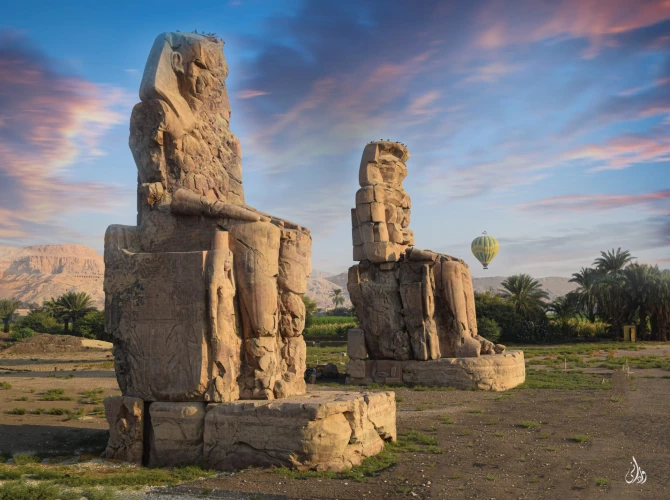
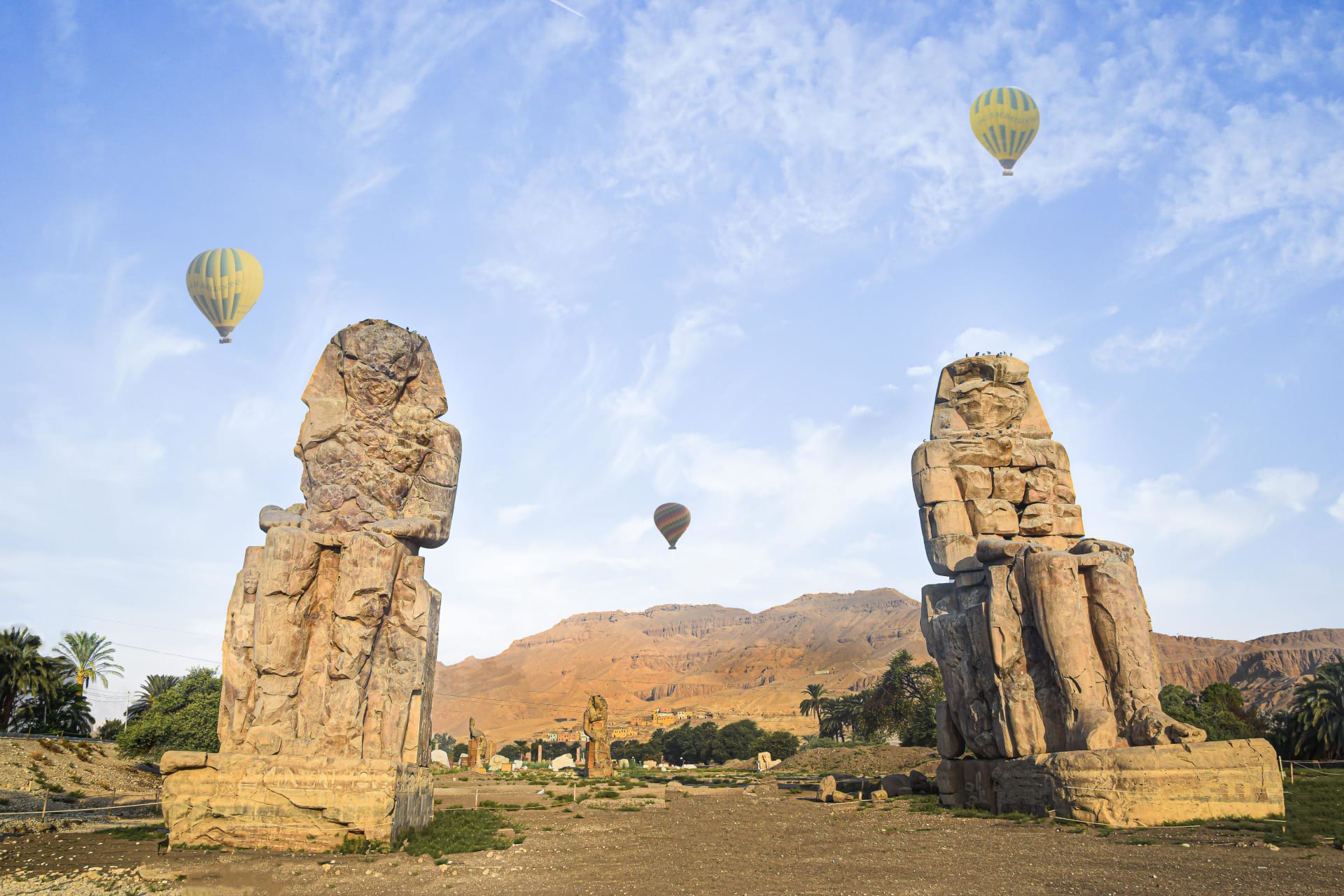
If you stand on the dusty west bank of the Nile in Luxor just as the morning sun starts to crest that far off horizon, a profound, almost mystical sort of quiet settles in the air. You feel the cool desert breeze come down from the jagged limestone cliffs of the Theban hills, it brushes through the nearby sugarcane fields, like it knows what it’s doing. Then, when the golden light finally lands on the fertile floodplains, two colossal shapes slowly show up out of the morning mist. Towering like ancient sentinels against the sky, they are, the Colossi of Memnon.
For more than 3,400 years these two massive stone statues have stayed in the same spot, enduring the rise and fall of empires, catastrophic earthquakes, Nile floods, and the steady footsteps of millions of visitors. They count as some of the most iconic and easily recognized monuments of Ancient Egypt , but still they’re among the most deeply misunderstood. Sure, a lot of casual travelers see them as just a quick, ten-minute photo pause on the way to the Valley of the Kings, however the Colossi are hiding a thrilling storyline behind those weathered sandstone faces… pharaonic ego, architectural genius, Roman romance, and an ancient, world-famous supernatural puzzle.
In this deep-dive, human centered travel guide, we’re going to look past the surface of these stone titans to get at the real king they represent, the legendary “singing” phenomenon that had the classical Roman world completely hooked, and also why the archaeological setting around them is now rewriting history, kind of fast, you know.
The Real Mastermind: The Glorious Reign of Amenhotep III
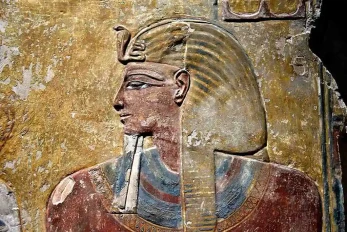
To understand why these statues exist, we kind of have to peel away their Greek nickname and just look back at the height of Egypt’s Golden Age—the New Kingdom. The Colossi don’t really represent some mythical Greek hero; instead they’re monumental portraits of Pharaoh Amenhotep III, the man who ruled Egypt during the 14th century BCE, more or less.
Amenhotep III’s reign wasn’t really defined by bloody foreign wars, but by unprecedented wealth, international diplomacy, and an almost overwhelming artistic splendour. He was arguably the greatest builder pharaoh in Egyptian history, and he’s credited with expanding the Luxor Temple, plus constructing that magnificent avenue of sphinxes.
The two Colossi were carved from single massive blocks of quartzite sandstone , quarried near modern-day Cairo and hauled over 400 miles overland to Thebes. That’s a staggering logistical feat for ancient engineering, no question. Each statue, and yes that includes the stone platform, towers roughly 60 feet (18 meters) into the air and weighs an estimated 720 tons. They show the pharaoh seated with great calm on his throne, hands resting on his knees, and he faces eastward toward the rising sun and the life-giving Nile. At his legs, there are two smaller figures too, beautifully carved, representing his beloved wife Queen Tiye and his mother Mutemwiya.
Guardians of a Lost Wonder: The Mortuary Temple
What lots of visitors do not really get, when they’re standing in front of the Colossi, is that they were never supposed to be there by themselves , in some empty sort of field. Back then , they were meant to guard the passageway, like kind of keepers, at the gateway.
The Colossi once stood at the huge entrance to the Mortuary Temple of Amenhotep III. At the time , this place was the biggest and most extravagant sacred complex anywhere in Egypt , stretching across 86 acres. In fact, it was even larger than the massive Temple of Karnak. It was basically a shining little world of courts , colonnades, sphinxes, and sanctuaries, built to honor the pharaoh’s special divine bond with the gods, not only while he was alive but also, moving forward, throughout eternity.
So, why did this architectural wonder vanish while other temples still stand ? The answer seems to be in a deadly kind of math by Amenhotep’s builders. They tried to place the temple as close to the sacred Nile as they could, so they set it right on the living floodplain. Over the years, the yearly Nile overflow quietly chewed away at the temple’s mudbrick base. And on top of that , around 1200 BCE, a major earthquake struck Thebes, knocking down most of the temple’s pillars and walls. For thousands of years after, the broken complex just became a convenient stone quarry for later pharaohs. Which left the two Colossi , as those lonely , stubborn reminders of a vanished world.
The Greek Myth and the "Singing" Statue
If the statues are meant to be Amenhotep III, how did they somehow end up being known as the Colossi of Memnon , well i t kind of gets tangled in a Greco- Roman cultural crossover.
Back in 27 BCE, yet another strong earthquake hit Luxor, and it did real damage. The northern Colossus got severely fractured, split from the waist upward , and the upper half collapsed. So after that kind of structural pain, something odd and kind of lovely began to show up. Every single morning, right at sunrise, when the first warm rays touched the damp stone , the northern statue would let out a strange musical sound. People said it was a delicate whistling, a metallic twang, or like the striking of a lyre, depending on who was watching.
The Greek and Roman travelers, who were arriving in Egypt in large numbers at that time, didn’t really sit around asking for natural causes right away. They reached back into their own stories and lore . They decided the statue must be Memnon, the mythical Ethiopian king and also a hero connected with the Trojan War, the one who was slain by Achilles. In the tradition, Memnon is the son of Eos, the goddess of the Dawn. So in their view, the morning song was Memnon calling out to his mother every day, and the morning dew, that fine moisture everywhere, was Eos’ tears falling because of her son.
The “Singing Statue” ended up being the ancient world’s total top tourist attraction. Roman emperors and poets , plus some generals and historians, made the long trip across the Mediterranean just to catch the voice of Memnon. A lot of travelers would scratch their names and this sort of poetic graffiti right onto the legs and the base of the statue, kinda like “proof” of what they heard , and those inscriptions still come through pretty clearly today for historians.
The whole mystery finally got sorted out (and also sort of destroyed by accident) around 199 CE , when the Roman Emperor Septimius Severus showed up at the site. He wanted to honor the deity and also fix the old monument, so he ordered the upper torso to be rebuilt after the collapse, using blocks of sandstone. That structural patch did more than restore it, it filled up the porous gaps and cracks , which meant Memnon’s singing stopped for good. Modern scientists think the sound wasn’t supernatural at all. Instead, it was natural, brought on by the quick evaporation of morning dew that had been trapped inside the porous, cracked stone, and then heated as the morning sun finally warmed everything up.
The Modern Renaissance: The Hour of Greater Discovery
For centuries, the area behind the Colossi was basically nothing more than an empty agricultural field. But, over the past few decades the place has seen a kind of spectacular archaeological renaissance, you know… like it never really stayed quiet. Thanks to the relentless, brilliant work done by the Colossi of Memnon and Amenhotep III Temple Conservation Project led by archaeologist Hourig Sourouzian, the lost mortuary temple is literally coming up from the earth again.
Right now, the ongoing excavations have brought to light dozens of spectacular colossal statues of Amenhotep III, and also beautifully preserved statues of the fierce Sekhmet, the lion-headed goddess. There are massive limestone stelae too. Scholars have carefully lifted a handful of collapsed colossi that once stood along the inner courtyards of the temple, so the open field behind the original two giants has been reshaped into one of the most active and exciting open-air archaeological parks in the world.
Insider Tips for an Elite Visit to the Colossi
To make your stop at the Colossi of Memnon feel really memorable, keep a few practical tips in mind, the kind that actually help when you’re there in person
Catch the Golden Hour: The best time is at sunrise, or in the early morning. You avoid the harsh Luxor heat and those large tour buses, and the soft morning light hits the face of the statues in a way that looks almost staged, capturing the same atmosphere that drew the old Roman travelers in the first place
Look for the Graffiti: Before you move on, take a moment and really watch the legs and the pedestals of the northern statue. You’re hoping to spot the elegant Latin and Greek inscriptions carved by ancient Roman tourists, thousands of years ago. It’s a small, tangible reminder, that we’re part of a longer human thread—constant curiosity, different centuries
Explore the Background: Don’t just stare at the two main figures, snap a photo, and walk away. Look across the fence into the excavation areas behind them. That view helps you notice newly raised statues and gives you a clearer sense of the immense scale of the original temple layout, because up close it’s larger than your brain expects



-webp.webp "Hilton")
-webp.webp "dusit")
-webp.webp "Marriott Hotels")
-webp.webp "Azimut Hotel")
-webp.webp "Golden Tulip")
-webp.webp "sheraton")
-webp.webp "westin hotel")
-webp.webp "Movenpick")
