
-webp.webp)
The Scholar’s Skyline: The Majestic Madrasa of Amir Sarghatmish
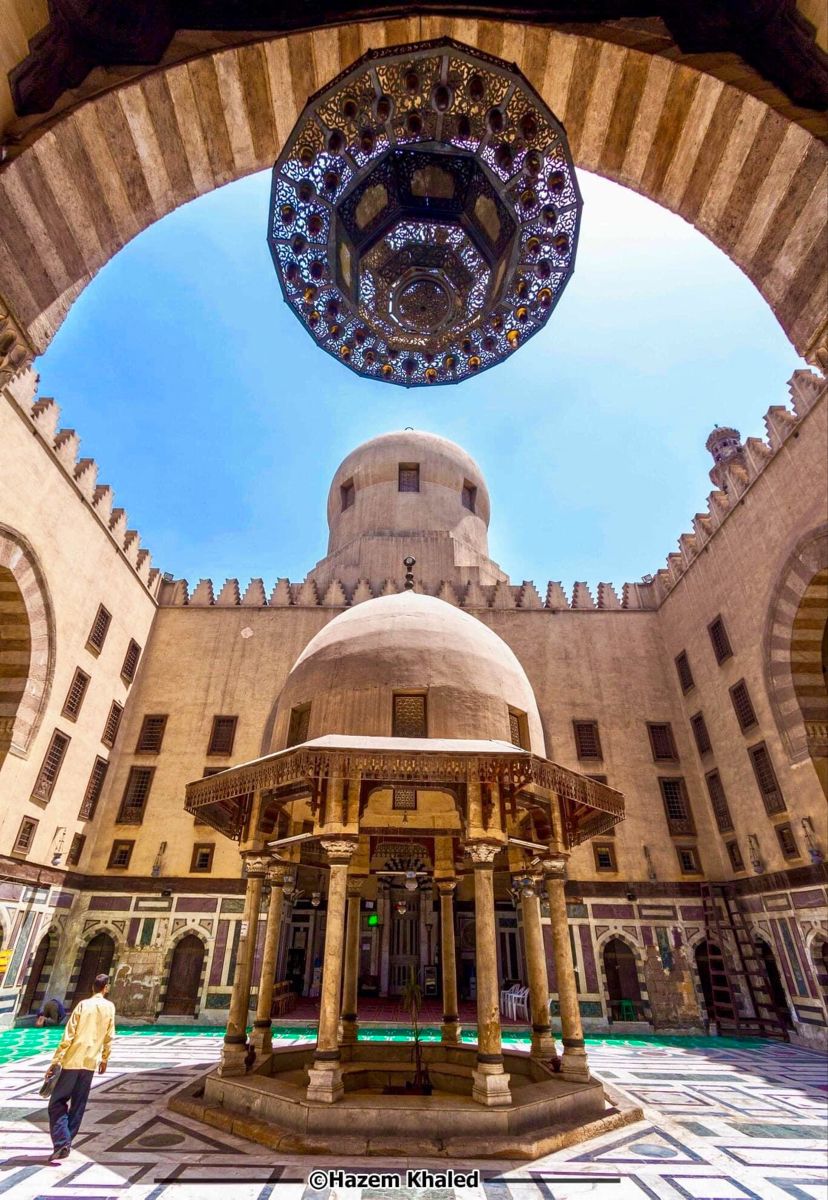
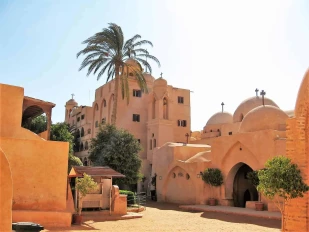
If you stand in the shadow of the great spiral minaret of Ibn Tulun and look toward the street, your eyes will be drawn upward to the three most beautiful domes which exist in the Cairo skyline. The Madrasa of Amir Sarghatmish serves as an educational institution. Built in 1356 AD, it served both as a sacred space for worship and as the most esteemed educational institution which focused on teaching Hanafi law during that period.
Current educational practices in 2026 treat educational institutions as separate entities from their historical sites while they approach teaching as a mechanical process which lacks human connection. The design of Sarghatmish building creates an educational environment which matches the inspirational power found in religious spaces because it serves as a 100% human facility. The building uses heavy stone materials together with ethereal light to create an experience which helps every visitor who enters through its main entrance to achieve mental elevation. The narrative describes a soldier who pursued his ambitions and found peace in a scholarly space while humans maintained their belief that knowledge acts as a path to God.
1. The Man of Power and Piety: Amir Sarghatmish
The building's design requires knowledge about its financial backer and his identity as the architect who approved all expenses. Amir Sarghatmish who served as a senior Mamluk official possessed strong determination which enabled him to survive the dangerous political environment of 14th-century court life. The elite class of his period experienced a clash between their ability to exercise authority and their complete human impulse to achieve permanent remembrance through nonviolent means.
The construction project became personal to Sarghatmish because he used his financial backing to support the building instead of claiming it as a tax deduction. The institution became his intellectual focus because he worked to develop its academic programs. The establishment employed top legal scholars from Islamic countries who spoke Persian while providing them with accommodation and high-paying positions.
The mausoleum at the madrasa serves as a memorial to his belief that people would speak his name during student prayers and lessons throughout the future. People experience this human weakness because they think that teaching others wisdom will make their voices exist forever.
2. Architecture of the Sky: The "Floating" Domes
The complex's main characteristic exists through its three separate domes which exist as the most exceptional element of the structure. The present-day domes stand elevated because their design uses thin supporting structures to achieve height, while earlier domes created a heavy atmosphere which seemed to push down on Earth.
The Double-Shell Engineering: These domes were a technical breakthrough. The architects designed the building through two brick layers which included an outer shell that created street-level height and a concealed inner shell which handled building space requirements. The public front presents an image of power, while the inner sanctuary provides complete human-friendly space for peace.
The Mihrab (Prayer Niche): The mihrab here is considered one of the finest in Cairo, featuring rare white marble and delicate carvings that look like they were drawn with a pen rather than cut with a chisel. The visual "anchor" directs people back to prayer space through its function of redirecting their gaze from the towering heights.
The Student Cells: The small rooms where students lived, which surrounded the courtyard, served as their living space. The tiny stone spaces make all human beings complete their first human experience, because they show us how young scholars with determination left their homes to live in basic conditions for the sake of discovering new ideas.
3. The Pulse of the Courtyard: Where Wisdom Lived
The central courtyard of Sarghatmish today creates an experience which feels like time moves at a slower pace. The building establishes its own weather system despite Cairo's modern traffic which operates beyond its protective boundaries.
The Environment of Learning: Sarghatmish teaches us that the beauty of our surroundings affects the quality of our thoughts. The hand-carved dome which you study law and philosophy under transforms your understanding of justice and ethics. You aren't just memorizing facts; you are absorbing a tradition of excellence.
A Neighborhood Anchor: Sarghatmish stands its ground against the Mosque of Ibn Tulun which represents one of the largest buildings in the world. The establishment does not compete with its competitor's size because it chooses to compete through its elegant design. The 100% human lesson demonstrates how to show confidence through silent behavior.
4. Why Sarghatmish Matters Today
The Madrasa of Amir Sarghatmish functions as a complete human educational model which demonstrates authentic educational methods for the present educational environment.
The building demonstrates that we exist as more than just our mental capabilities. The learning process requires us to experience beauty and sunlight and historical environments. The "Floating Domes" function as physical objects which demonstrate how human beings desire to transcend ordinary existence.
The Gift of Continuity: The fact that we can still walk through these halls 670 years later demonstrates how Mamluk artisans created durable structures which withstand the test of time. The modern world offers us temporary solutions which exist as "disposable" items but it challenges us to consider which present-day constructions will become future inspirations for people living in 2700.
The Heights of Knowledge
The Madrasa of Amir Sarghatmish functions as an architectural monument which serves as the "Scholar's Skyline." The structure demonstrates the period when Cairo functioned as the global intellectual center and one man's dream established a place for truth seekers to find knowledge.
Visitors who enter through its arched entrance can observe the double-shell domes while they create a mental picture of all the legal discussions which have taken place within these walls throughout history. The space serves as a complete human refuge which transformed a street intersection into an ascending path that leads to the sky because it treated knowledge acquisition with the same honor given to royal crowning ceremonies.



-webp.webp "Hilton")
-webp.webp "dusit")
-webp.webp "Marriott Hotels")
-webp.webp "Azimut Hotel")
-webp.webp "Golden Tulip")
-webp.webp "sheraton")
-webp.webp "westin hotel")
-webp.webp "Movenpick")