
The Real Story of Egypt's Priests, Faith, and Eternity
.jpg)
The Sacred Hierarchy: From Ordinary Priests to High Prophets
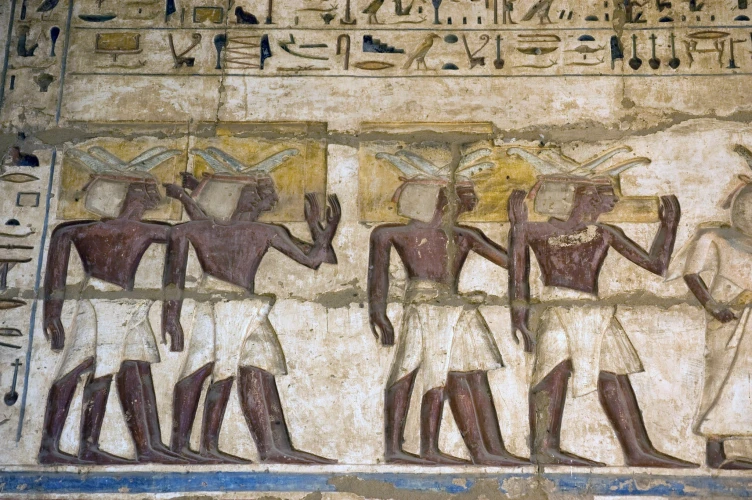
Priests. The priesthood was carefully organised, many positions during the earlier period in the hierarchy being occupied by nobles and officials. But by the New Kingdom it had become a professional body. The ordinary priest, or wb priest, was the lowest order, and the aspirant to high office became successively third prophet, second prophet and first prophet or high priest. Certain priests were reciters while others were concerned with the service for the dead. Women were priestesses of certain goddesses such as Hathor, Isis or Bastet; others were chantresses of Arnun, and singers for other male deities. The priests of Sekhmet concerned themselves with medical practices.
The Love for Life: Shifting Perspectives on Funerary Practices
Funerary Beliefs and Practices. Because of the way that sites have been excavated in Egypt, most material has come from either tombs or temples, which, combined with the classical view that the Egyptian people were the most religious in the ancient world, has encouraged theories that they were obsessed with death and the Afterworld. Actually little work has been done on the major Egyptian cities, but if this were redressed the Egyptians' attitude would doubtless be better understood. It seems rather that they were devoted to life, and could not imagine anything better, and so based their ideas of the Afterworld on that of their own everyday life. However, funerary beliefs are never simple, and in Egypt they cover a particularly long time, during which many ideas changed, or were grafted onto earlier ones. It
is extremely difficult to give an idea of the religious beliefs and funerary practices of all classes of Egyptian society. Originally the best was obviously reserved for the king and the nobles, and it is from their tombs that most information comes. The poorer folk were, like those of the predynastic period, often wrapped in skins, baskets or linen shrouds, and placed in the sand where their bodies survived remarkably well owing to the very dry environment.
The Osirian Revolution and the Origins of Mummification
There is no doubt that the Egyptians' desire to preserve the body came from having 40 FUNERARY BELIEFS AND PRACTICES observed the state of preservation of some of these early burials, conditions they tried to duplicate when carrying out their own. No definite treatise on mummification exists, but as belief in Osiris grew, and as his powers became diversified (originally only the rulers and ruling classes benefitted from his ministrations), so did the belief in resurrection spread. The Greek authors who were inter-ested in embalming inform us that mummification took about 70 days, bU:t there is one case of an Old Kingdom queen which took about 285 days, perhaps because her tomb-chapel was not ready. Evidence for the commencement of embalming is uncertain. Already by the 3 Dyn. the body was being dismembered and the limbs wrapped to represent the living body, but by the 4 Dyn. it was certainly taking place, and one of the earliest examples known is that of Hetepheres, mother of Khufu, builder of the Great Pyramid. Although her body was missing from her tomb, the box containing the canopic jars (see below) was present, evidence that she must have been embalmed.
Inside the Embalmer's Workshop: The New Kingdom Methods
Very few mummies have remained from the Old and Middle Kingdoms, but by the New Kingdom the main methods used to preserve the body were understood. The word mummy comes from the Arabic mii.mmiya (bitumen), the material in which bodies were later soaked in an effort to preserve them, and has really nothing to do with the Egyptians' earlier efforts. The method seems to have been a dry process in which the soft parts of the body like the stomach, intestines and liver, were taken out and placed either in jars or wrapped in bundles; the brain was also usually removed but not the heart. Natron was used to purify and preserve the body, the body cavity was washed out with palm wine, and the body stuffed to preserve its contours




-webp.webp "Hilton")
-webp.webp "dusit")
-webp.webp "Marriott Hotels")
-webp.webp "Azimut Hotel")
-webp.webp "Golden Tulip")
-webp.webp "sheraton")
-webp.webp "westin hotel")
-webp.webp "Movenpick")