
-webp.webp)
The Mystery Behind the Crystal Eyes of Ka-Aper statue
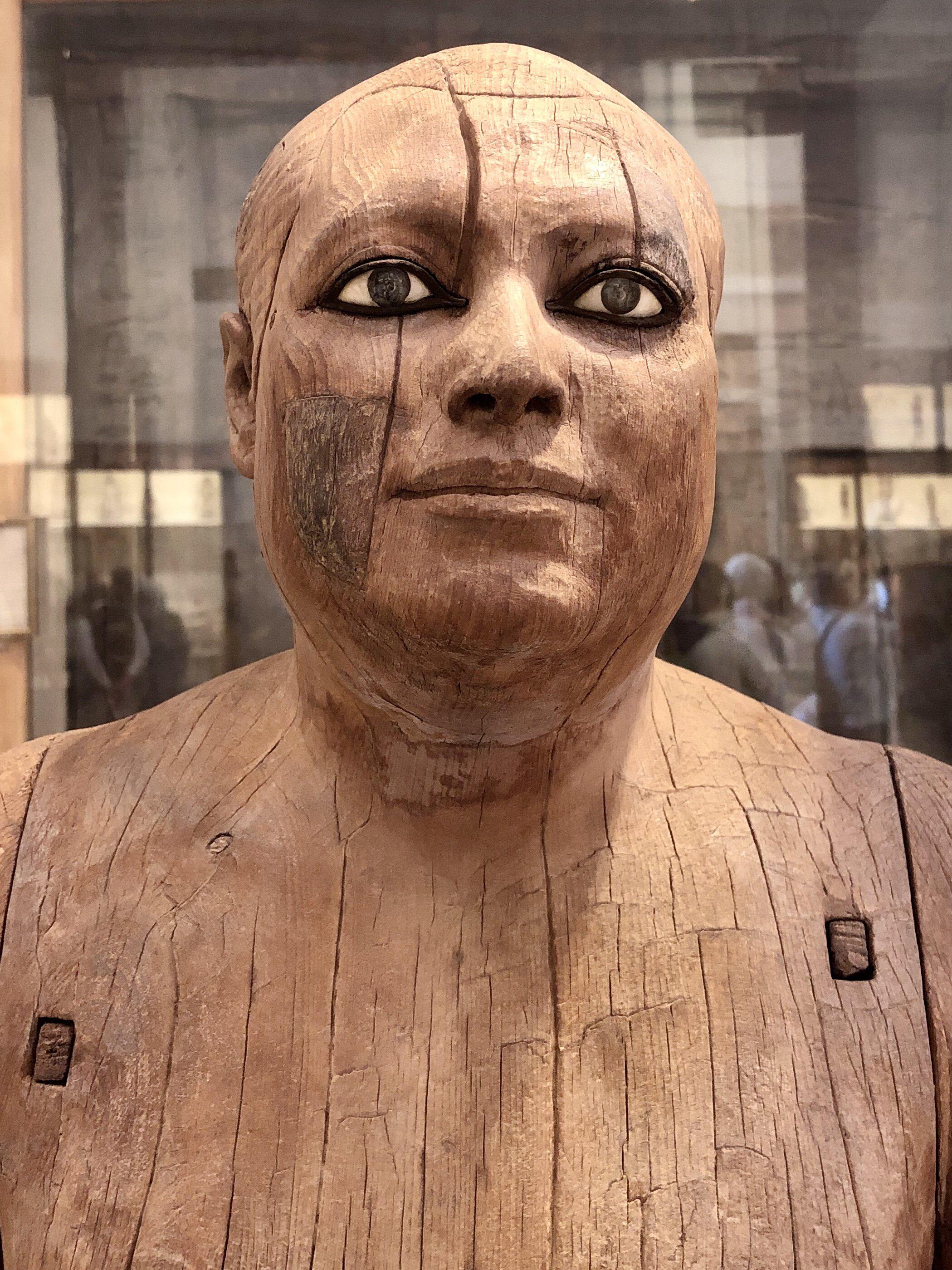
Of all the treasures in the Egyptian Museum in Cairo, few have the power to stop a traveler in their tracks quite like Ka-Aper. You might be walking through the gallery, overwhelmed by gold and colossal stone, and suddenly you feel it: someone is watching you. You turn, and there he is—a stout, middle-aged man with a walking stick, looking at you with a gaze so piercing and lifelike that it feels as though he might clear his throat and start speaking.
Known famously as "Sheikh el-Beled" (the Village Chief), this 4,500-year-old wooden statue is a masterpiece of Old Kingdom realism. But the true secret to his "soul" lies in his eyes. In the 2026 season, as we lean more into the "human" stories of the past, the crystal eyes of Ka-Aper stand as a testament to an ancient optical technology that remains almost impossible to replicate.
1. The Moment of Discovery: "The Village Chief"
To understand the power of these eyes, we have to go back to 1860, when Auguste Mariette’s excavators unearthed the statue in the necropolis of Saqqara.
-
The Legend: When the local workmen saw the statue emerging from the sand, they were terrified. The face looked so much like their own local village headman (the Sheikh el-Beled) that they were convinced they had dug up a living man.
-
The Human Connection: It wasn't the wood or the belly that scared them; it was the eyes. Even after thousands of years in total darkness, Ka-Aper’s gaze was clear, moist, and eerily intelligent.
-
The Status: Ka-Aper wasn't a King; he was a "Lector Priest" and a government official. Because he wasn't royal, his artists were allowed to bypass the "perfected" athletic look of the Pharaohs and carve a real human being—complete with a bit of a "dad bod" and a face full of character.
2. The Optical Engineering: How the Eyes "Work"
In 2026, we often think of the ancient world as technologically "simple." Ka-Aper’s eyes prove otherwise. They are not merely painted stone; they are a complex assembly of mineral components designed to mimic the human anatomy.
-
The Sclera (The White): The "white" of the eye is carved from opaque white quartz or magnesite.
-
The Cornea: A piece of polished, transparent rock crystal (clear quartz) is set into the center. This crystal is shaped like a lens, which captures and refracts ambient light just like a real eye.
-
The Pupil: Behind the crystal lens, a small hole was drilled and filled with black resin or a dark pigment. Because of the way the light hits the crystal "lens," the pupil appears to move and follow you as you walk past the statue.
-
The Eyelids: The entire assembly is held in place by copper frames that mimic the shape of the eyelids and eyelashes. Over time, the copper has oxidized, giving him a slightly "shadowed" look that adds to the depth of his expression.
3. The Psychology of the Gaze
Why did the Egyptians go to such incredible lengths to create "real" eyes? For a priest like Ka-Aper, the statue was his Ka-statue—the physical vessel for his spirit in the afterlife.
-
To See is to Exist: In the Egyptian mindset, the senses were vital for survival in the next world. A statue that could "see" the offerings being placed before it was a statue that was truly alive.
-
The "Opening of the Mouth" Ritual: During the funeral, priests would perform a ritual to "open" the senses of the statue. By giving Ka-Aper these crystal eyes, the artists ensured that his "Opening of the Eyes" was permanent.
-
A Gaze Across Time: When you look at him in 2026, you aren't just looking at an artifact; you are engaging in a 4,500-year-old stare-down. He looks back at us not as a god, but as a man who lived, breathed, and worked in the shadow of the Pyramids.
4. Comparison: The "Living Eyes" of the Old Kingdom
| Statue | Era | Eye Material | Vibe |
| Ka-Aper (Sheikh el-Beled) | 5th Dynasty | Rock Crystal & Copper. | Alert, authoritative, and warm. |
| The Seated Scribe | 4th/5th Dynasty | Magnesite & Crystal. | Intense, focused, and ready. |
| Rahotep & Nofret | 4th Dynasty | Inlaid Quartz. | Haunting, noble, and "present." |
5. Why Wood Matters
Most of the famous statues we see from this era are made of limestone or granite. Ka-Aper is made of sycamore wood.
-
The Rarity: Wood is organic and usually rots. The fact that Ka-Aper survived is a miracle of the dry Egyptian climate.
-
The Flexibility: Wood allowed the artist to create a much more fluid, "moving" posture. Ka-Aper is caught in mid-stride, his walking stick in hand.
-
The "Human" Texture: Wood has a warmth that stone lacks. When combined with the crystal eyes, the material makes him feel like a neighbor rather than a monument. In 2026, we are learning that the Egyptians chose wood specifically for its "life-like" qualities for non-royal elites.
6. Finding Ka-Aper in 2026: A Visitor’s Strategy
In the 2026 season, the "Grand Shuffle" of artifacts between the Tahrir Museum and the GEM is largely settled. Currently, Ka-Aper remains a highlight of the Egyptian Museum in Tahrir Square.
-
Go Early or Late: To truly feel the "power" of the eyes, you need a moment of silence. Avoid the mid-day school groups.
-
The "Follow" Test: Walk slowly from the left of the statue to the right. Watch the pupils. You will notice that he never loses eye contact with you. It’s a 4,500-year-old "motion tracker."
-
Check the Lighting: The Tahrir museum’s high windows provide natural, shifting light. See how his expression changes as the sun moves. In the morning, he looks stern; in the late afternoon, his eyes take on a softer, more reflective quality.
7. The Humanized Reflection: What He Sees
There is a profound irony in standing before Ka-Aper. We go to the museum to "see" the past, but he is the one who seems to be doing the observing.
He has seen the rise and fall of the Roman Empire, the birth of modern Egypt, the arrival of the first steamships on the Nile, and now, the digital-heavy world of 2026. Through his crystal lenses, he has watched millions of humans pass by his glass case.
When you look at him, try to think about what he represents: Dignity. He isn't a King with a crown, but he stands tall, confident in his role and his life. He reminds us that the "Old Kingdom" wasn't just a collection of pharaohs—it was a society of people who wanted to be remembered for exactly who they were.
8. The Final Verdict
The crystal eyes of Ka-Aper are more than just a clever trick of mineralogy. They are a bridge. They prove that the ancient Egyptians mastered the "Uncanny Valley" long before we had a name for it.
When you leave his gallery, you’ll find that you remember his face more than almost any other in the museum. Not because it was the most beautiful, but because it was the most human. Those crystal eyes are a 4,000-year-old reminder that the people of the Nile didn't just want to "survive" death—they wanted to keep watching the world they loved.



-webp.webp "Hilton")
-webp.webp "dusit")
-webp.webp "Marriott Hotels")
-webp.webp "Azimut Hotel")
-webp.webp "Golden Tulip")
-webp.webp "sheraton")
-webp.webp "westin hotel")
-webp.webp "Movenpick")