
-webp.webp)
The Journey of the Holy Family in Egypt: History, Legacy, and Sacred Sites
The Sacred Flight: Tracing the Historic Journey of the Holy Family in Egypt
Throughout the ages, the territory of Egypt has always remained a safe haven for thousands who sought refuge from hunger, war, and persecution. However, of all of the many migrations that have ever occurred throughout the history of Egypt, perhaps the most spiritually symbolic has been a secret, dangerous pilgrimage that took place some two thousand years ago – the flight of the Holy Family into Egypt.
Having received divine guidance through a dream sent by an angel, Baby Jesus, Virgin Mary, and St. Joseph the Carpenter embarked on a long journey to escape from Herod's cruel edict, not as rulers or conquerors, but as fugitives traveling thousands of kilometers away from home. Nowadays, a remarkable trail of springs, grottoes, and holy trees that these biblical characters left behind is a unique blend of faith, history, and culture.
Now, let us carefully explore the route that they took.
1. The Divine Command: Fleeing into the Desert
Historical and Biblical Context of the Journey Begins in Bethlehem
According to Matthew’s gospel, King Herod grew concerned about prophecies regarding birth of a baby boy who would become a "King of the Jews". In reaction to those rumors, Herod ordered the murder of all male children below two years of age.
In a dream an angel addressed Joseph with instructions to wake up, and leave that same night taking both child and His mother and flee to Egypt until instructed otherwise.
There were several reasons why Egypt could be chosen as a destination. First, this country fell out of reach of the rule of King Herod. Second, there was plenty of traffic from other countries and thirdly, Egyptians had many Jewish colonies established in their trade centers. The escape happened during the night when the family started moving on a long route through the barren lands of Sinai Desert to enter Egypt.
2. Entering the Land: From Sinai to the Delta
The first stops made inside the land of Egypt by the Holy Family saw them suffer tremendously, while also receiving the unexpected kindness of the people who inhabited the area. They traveled from Farma, which is the ancient Pelusium, situated at the eastern part of today's Suez Canal, through the hot and sandy desert before moving westwards into the fertile delta region of the Nile River.
Amongst the well-known early places they stopped by were Bubastis, which currently lies near Zagazig. During that period, Bubastis was a big city devoted to the Egyptian cat goddess Bastet, and characterized by tall temples and giant idols made out of stone.
According to the Coptic tradition, as the Holy Family entered the town, these giant figures crumbled down under their feet in response to the divinity of the baby. The priests were so shocked that they did not offer the family any refuge.
The Holy Family was very exhausted and thirsty when Saint Joseph hit the ground using his cane; and there came a spring full of clean water. The family rested under the shade of a tree.
3. Seeking Shelter in Cairo: The Caves and the Trees
As the family traveled further south, away from the watchful eyes of Roman outposts in the Delta, they somehow reached the area we now call modern day Cairo. Back then, it was a highly strategic point, near the ancient Roman fortress of Babylon.
Deep in the labyrinthine alleyways of Old Cairo there is the Church of Abu Serga, also referred to as Saint Sergius and Bacchus. This church was built right over a subterranean cave, and it feels like one of the most sacred stops of the whole journey , even if people try to rush through it.
Inside, the Holy Family stayed concealed in that small, damp cave for several weeks. These days, visitors can climb down into the cool, stone crypt and see the place where the Virgin Mary cradled her child. The air in the crypt feels heavy, thick with centuries of prayer. It gives a quiet, a bit humbling glimpse of what their life as refugees really was, not just a story told once and done.
A little farther north, in the district of Matariya, sits an ancient sycamore tree called Mary’s Tree. Local lore says that when Roman soldiers kept pressing after them, the sycamore branches opened up in a kind of miracle, hiding Mary and Baby Jesus in the dense leaves until the danger passed. The tree still stands today, surrounded by a calm garden, its twisted , ancient bark like a living testament to how the family survived all that relentless peril.
4. Sailing the Nile: The Voyage to Upper Egypt
Realizing that city life kept bringing them this constant risk of being discovered, the Holy Family made some kind of pivotal call. They chose to get on a wooden sailboat and go south, down the Nile, toward that remote rugged stretch people call Upper Egypt
Before they boarded, the family went through the Delta town of Bikha Isous, which is today known as Sakha. They say Baby Jesus pressed his small foot against a stone here , and it left this clear impression. For centuries, that sacred thing—called the Footprint of Jesus—was kept away by monks, sort of hidden so looters wouldn’t take it, until it was rediscovered in the late 20th century. Now it’s a place that pulls in thousands of faithful, who come to touch the stone and ask for blessings
Later, the family finally boarded a boat at Maadi, a southern suburb of Cairo right there along the Nile’s banks. There now stands the Church of the Virgin Mary, on the exact point where they stepped onto the water
Then in 1976, something genuinely remarkable caught the country’s attention. A heavy, leather bound Bible turned up floating on the river’s waves, right outside the church. It was found opened to the Book of Isaiah, showing that well known verse about blessings for the land of Egypt
5. The Ultimate Sanctuary: Al-Muharraq Monastery
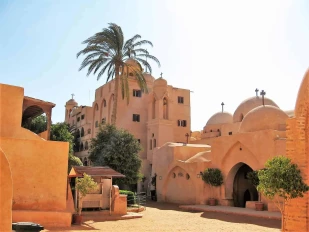
The furthest, and at the same time most important point of the Holy Family’s traveling took them pretty deep into Upper Egypt, all the way to the foot hills of Mount Qosqam near Asyut. There they came upon their final and also most lasting resting place, what today people call the Al-Muharraq Monastery.
The Holy Family stayed there for just a little over six months, in a plain mud brick cave set along the mountain slopes. In fact, this was their longest settling anywhere across Egypt, and it felt like a quiet, unbothered pause, far away from the frightening things tied to Herod’s regime.
The cave where they slept was later consecrated, and it became the altar of the ancient Church of the Virgin Mary inside the monastery complex. For Coptic Christians, that altar is treated as the first sanctuary in the world, not shaped through human hands, rather, it was blessed by Christ’s living presence during his early childhood, or so they believe.




-webp.webp "Hilton")
-webp.webp "dusit")
-webp.webp "Marriott Hotels")
-webp.webp "Azimut Hotel")
-webp.webp "Golden Tulip")
-webp.webp "sheraton")
-webp.webp "westin hotel")
-webp.webp "Movenpick")