
-webp.webp)
The Face of Cleopatra and the Cosmic Sky: A Journey Inside Egypt’s Dendera Temple
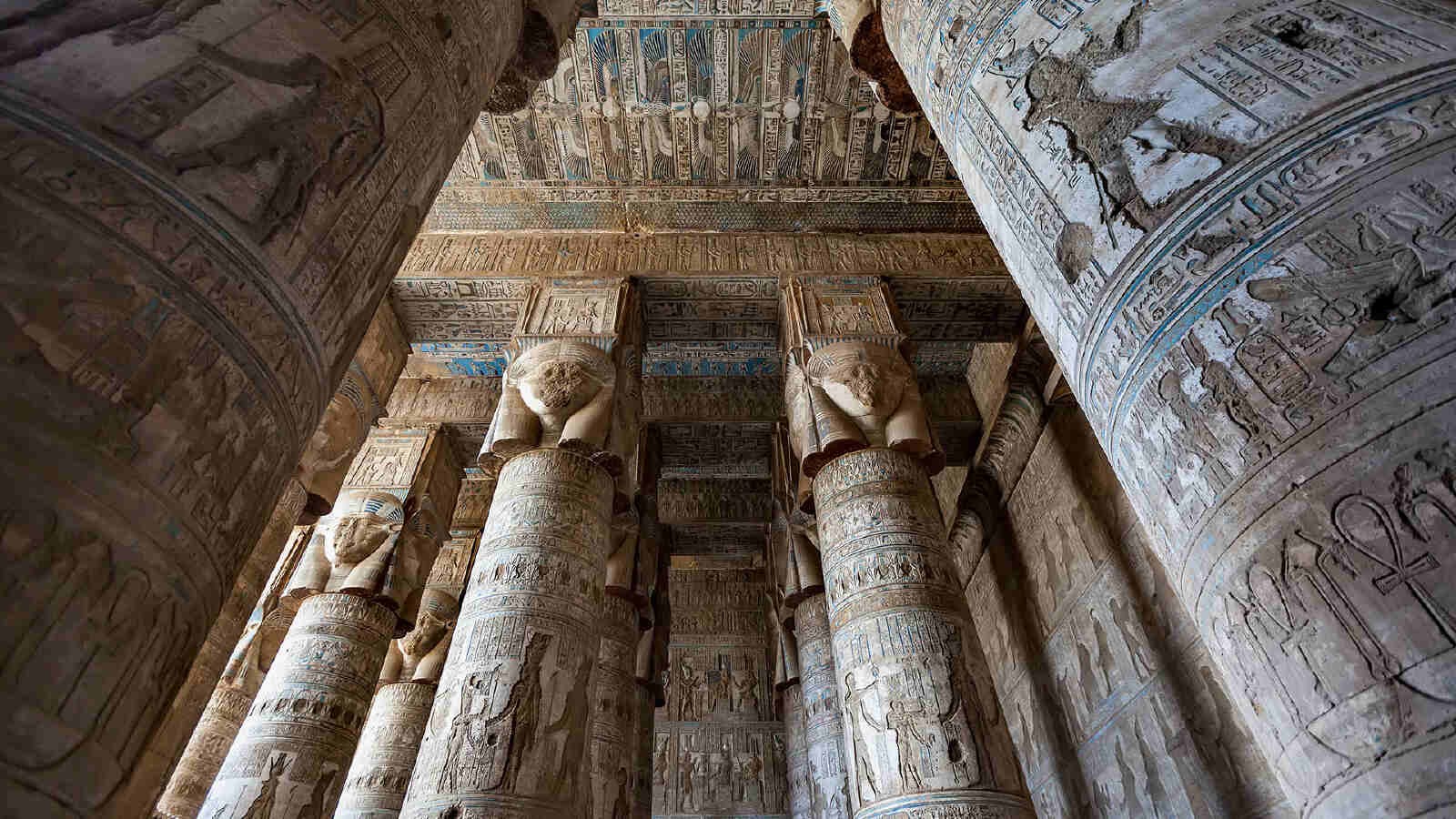
The Indigo Ceiling: Unlocking the Astronomical Magic and Sacred Art of Dendera Temple
There’s a moment that feels almost cinematic awe waiting for anyone who wanders just north of Luxor to the ancient city of Qena. You push through this monumental sandstone gate, then you cross a sun-baked courtyard and suddenly you’re right in front of the towering face of the Dendera Temple Complex. You shield your eyes from that intense Egyptian glare, slip inside the first big Hypostyle Hall, and when you finally look up your breath kind of stops.
Above you, there’s this huge ceiling, soaring and still, bathed in this surreal shade of deep indigo. And it’s not like most other ruins in Egypt, where centuries of soot smoke and plain time have sort of dulled everything inside. Here at Dendera the ceiling seems meticulously cleaned, like the original vibrant paint was kept safe. It becomes this stunning, cosmic patchwork of astronomical diagrams, golden stars, sailing sun boats, and Nut the sky goddess whose protective form stretches out, swallowing the evening sun then setting the dawn back in motion. Standing there, the ancient world doesn’t feel dead or far away, it feels—somehow—blindingly alive.
Most of it is dedicated to Hathor, the goddess of love joy, music, fertility, and cosmic healing. Dendera is also one of the most remarkably preserved temple complexes anywhere in Egypt. Yes, the structures you see today were built mostly during the late Greco-Roman period, but the place itself has been a steady center of sacred power since the Old Kingdom. In this guide, it’s not the usual, straight-through tourist route. We’ll move past the common paths to explore the architecture, the vibrant astronomical art, the lingering historical mysteries, and the practical travel tips for Dendera.
1. The Sanctuary of Joy: The Cult of Hathor
To really get Dendera, you have to get a grip on the goddess who kind of ran the whole show there. Hathor wasn’t just some far away, grim shadow deity. Instead she was basically the ultimate, personification of feminine strength, comfort, and festivity. She was the sky goddess, yes but also the patron of musicians and dancers , cosmetics and those careful weavers. She even greeted the dead in the afterlife with cool food and drink, and she sparked joy in the living, like intoxication turning into ecstasy.
So because of that , Dendera never felt like a dreary or silent place. In antiquity it was more like a bustling, living sanctuary. The festivals were well known, especially the Feast of the Beautiful Meeting. During it the sacred statue of Hathor was set on a grand Nile barge , then sailed south to Luxor so she could be ceremonially joined with her husband Horus at the Temple of Edfu. And if you look closely, the walls of Dendera are like a musical score carved into stone. They show priests in ordered lines playing sistrums, those sacred rattles, plus shaking tambourines , and pouring libations of sweet wine, all to keep the cosmos in balance and harmony.
2. Architectural Marvels: The Sistrum Pillars and the Hypostyle Hall
The architectural centerpiece of the complex is the Great Temple of Hathor, and honestly the entrance feels like it’s already shouting at you. It has this striking massive facade, held up by 24 colossal columns. What makes these pillars really, entirely unique is their own design, like they’re not just decorative. They’re Hathoric columns and each one is carved with the four-sided face of the goddess herself, with her distinctive cow ears, her calm, composed expression, and that heavy wig she always seems to wear. Then the tops… they’re shaped like a sistrum, so in a symbolic kind of way the whole hypostyle hall gets turned into a huge divine musical instrument.
If you keep going, and you wander deeper into the temple’s maze of dark subterranean crypts, plus those hidden side chambers, you start noticing how consistent the craftsmanship is. Since Dendera was built during the Ptolemaic and Roman eras, roughly 54 BCE up to the time of Emperor Trajan, the art style kind of mixes older Egyptian religious iconography with the softer more voluptuous realism you’d associate with Hellenistic and Roman sculpture. You can see it especially in the figures of the queens and goddesses, they have this dynamic rounded physical presence, and it’s noticeably different from the leaner more rigid lines you get in older New Kingdom temple work.
3. The Dendera Zodiac: A Cosmic Blueprint
For historians, astrologers, and stargazers , the absolute crown jewel of Dendera is sitting up there, on the upper roof level. It’s inside a dark little chapel, sumptuously decorated, dedicated to the resurrection of Osiris. If you look upward, straight at the ceiling of that chamber, you get met by the Dendera Zodiac.
The original piece—yeah, the one that was controversially removed from the ceiling by French collectors in 1821 and is now in the Louvre Museum in Paris— is shown on site by a flawless dark plaster replica. This replacement is a monumental, circular bas-relief chart, mapping the ancient Egyptian sky with an almost unreal kind of mathematical precision.
It is the only circular zodiac we know of in ancient Egyptian architecture. Somehow it blends, without too much fuss, the older Babylonian and Greek astrological symbols with indigenous Egyptian star patterns. Take a careful look, and you will quickly spot the familiar outlines of Taurus the bull, Scorpio the scorpion, and Leo the lion, all around the 36 decans. These decans are the stars that marked the hours of the Egyptian night. In the end it feels like a real proof of advanced sky-lore in the ancient world, showing that for the Egyptians, the temple was a direct earthly counterpart of the cosmos.
4. History and Contradiction: The Face of Cleopatra VII
Dendera sort of holds an elite place in historical romance, mostly because it includes one of the very few authentic, present-day portraits of Egypt’s most legendary queen Cleopatra VII
If you walk around to the exterior back wall of the temple , you’ll see a towering monumental relief carving. It shows Cleopatra VII standing side by side with her son Caesarion , whose father was the Roman dictator Julius Caesar. Honestly the whole thing feels like a political propaganda masterclass; Cleopatra is shown as the living embodiment of the goddess Isis, while she makes grand offerings to Hathor, all to legitimize her rule, and to secure her son’s future on the throne of Egypt
Then, standing under the carved profile of history’s most captivating queen, right there against the very stone she commissioned , you get this spine tingling moment for any historical traveler.
5. The Enigma: The Dendera "Lightbulbs"
No modern talk about Dendera is ever really finished without bringing up those oddly mesmerizing, heavily discussed reliefs that are tucked away deep in the temple’s narrow stone crypts. You can only get to them by, basically crawling through this tiny, square opening in the floor. Once you’re in, the subterranean chambers hold what people call the Dendera Lightbulb reliefs, or you know, that thing that everyone argues about.
The carvings show ancient figures gripping big, stretched bulb-like objects. Inside them there’s that wavy line, kind of like a snake, and it’s anchored at the bottom by a lotus flower. Above or behind it there’s also a pillar that looks a lot like an electrical insulator, at least to modern eyes. And yeah, alternative historians, plus various internet theorists, keep returning to these walls like they’re the final, undeniable evidence that the ancient Egyptians had electricity or, somehow, advanced alien tech to illuminate their dark tombs.
But the real story , at least the human version, based on what’s readable in the nearby hieroglyphic texts, is honestly way more poetic. Those scenes, they’re not a blueprint. They’re a creation myth. The “bulb” is more like a protective bubble, or even a womb of the sky, while the lotus stands for the arrival of a new dawn. The snake inside is Harsomtus , also known as Horus the Unifier, coming up from the primordial waters to bring light and life to the cosmos at the start of the Egyptian New Year. So it’s an artistic metaphor for cosmic rebirth, not some secret electrical diagram hidden in plain sight.
Insider Tips for an Elite Journey to Dendera
So the Ultimate Day Trip Combo is kinda like this: Dendera sits about 45 miles north of Luxor. If you want the absolute best way to feel it for real you should book a private air-conditioned car and do a full day safari, pairing Dendera with the other spectacular Abydos Temple. Doing both in one day feels like an almost unmatched lesson in Egyptian art, theology, and just the bigger story behind it.
Also , don’t skip the roof part. Dendera is one of the rare temples where visitors are allowed to climb the dark , twisty interior staircases right up to the upper roof. The staircase walls are carved with moments of the priests carrying statues of the gods , up to the roof so they can be “recharged” by the sun’s rays. From up there the view across the surrounding green Nile valley and out toward the desert cliffs is genuinely breathtaking.
Now bring the right gear, seriously. To photograph the intricate parts of the cleaned blue ceiling and then the darker, tight crypt spaces , bring a wide-angle camera lens. And add a good flashlight or at least a reliable phone light, because those corners get very dark.



-webp.webp "Hilton")
-webp.webp "dusit")
-webp.webp "Marriott Hotels")
-webp.webp "Azimut Hotel")
-webp.webp "Golden Tulip")
-webp.webp "sheraton")
-webp.webp "westin hotel")
-webp.webp "Movenpick")