
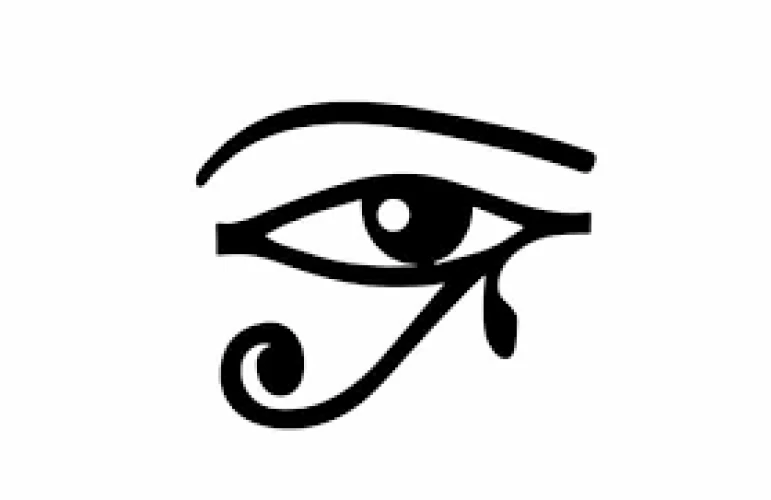
The Eye of Ra Explained: Meaning, Myth, and How It Differs from the Eye of Horus
The Eye of Ra: The Blazing Sun of Wrath and Cosmic Power in Ancient Egypt
Looking at the majestic remains of ancient Egypt, one's mind inevitably wanders towards ideas of peaceful pharaohs, perfect symmetry, and an overwhelming desire for eternal peace. However, the apparent cosmic tranquility of this culture hides an equally powerful and primordial force – something destructive and deadly, something capable of total annihilation and rebirth after it. This blinding force found its manifestation in one of the most mysterious and fearful symbols in all of Egyptian mythology – the Eye of Ra.
There seems to be quite a misunderstanding among many people, who consider the Eye of Ra to be exactly identical to the Eye of Horus, and there are good reasons for such confusion. Both symbols share similar appearance, but they differ dramatically when it comes to symbolism and philosophy behind them. While the Eye of Horus symbolizes restoration and gentle protection, the Eye of Ra symbolizes blazing wrath of the sun and the fiery protection of the cosmic order.
Let us embark on the journey into ancient times and explore the mysteries of this blinding symbol of solar deity.
1. What is the Eye of Ra? (The Divine Paradox)
While in ancient Egypt, the Eye of Ra was seen as more than simply a physical attribute of the solar deity. Rather, it was regarded as an independent and powerful creature that had its own consciousness and free will.
The Eye is, thus, Ra’s female equivalent and manifestation on Earth, an embodiment of the power of creation that he wields and uses to crush all his enemies. It is his tool with which he maintains Ma'at (the holy principle of truth, justice, and cosmic balance) and preserves harmony within the world. The Sun is like Ra in that he is a benevolent deity who blesses the earth with warmth and light; but his Eye is the destructive power of the heat of summer, the plague that kills and causes suffering.
2. The Myth of the Distant Goddess: The Destruction of Mankind
In order to fully comprehend the horror of this symbol, it is essential to examine the key myth surrounding it, which can be found in the holy book known as The Book of the Heavenly Cow.
According to the legend, once Ra had aged, man conspired against him, ignoring his divine commands and duties toward Ra. Filled with wrath, Ra called on a council of elder gods. They recommended that he should call on his Eye to punish humanity.
He removed his Eye from his forehead and unleashed it against humanity. His Eye turned into the lioness goddess Sekhmet, who massacred people with unrestrained rage. Sekhmet was addicted to her massacre and enjoyed murdering people to such an extent that she could not stop. The river of the land flowed with people’s blood, and mankind faced its doom.
After realizing that his punishment was too much, Ra was extremely remorseful. Nonetheless, nobody could have stopped the ferocious lioness in full attack except for Ra who would have to employ some tricks. Ra instructed the priests to concoct a large amount of pomegranate juice, red ochre, and barley beer into an enormous number of 7,000 jars of beer, which was a bright red liquid.
The priests poured the liquid in abundance all over the land. On waking up and coming to continue with her killing spree, she noticed her own reflection in the red beer, which she thought was blood. She consumed the beer and got intoxicated until she slept. Upon waking up, the desire to kill had ceased from her, hence transforming into the gentle goddess Hathor.
3. The Multi-Faceted Goddesses of the Eye
As the Eye of Ra was an independent power, it took various forms of goddesses according to its moods. It did not appear as an idea; rather, it existed as a living deity.
Sekhmet: Sekhmet symbolized the wrathful aspect of the Eye of Ra. As a lioness, she symbolized the fierce and blinding heat of noon sun, which caused droughts and diseases.
Hathor: While Hathor was the gentle and pleasant version of the Eye. Whenever the Eye of Ra was pacified, it transformed into Hathor – a goddess of pleasure, music, love, and fertility. Thus, it was believed that there was a destructive element present in creation.
Bastet: In the form of a cat, Bastet symbolized the protective aspect of the Eye of Ra. She protected both the household as well as the Pharaoh from invisible threats.
Wadjet: In her snake form, Wadjet was present upon the head of the Pharaoh as Uraeus, spitting fire at the enemies of the Pharaoh.
4. Visual Symbolism and the Uraeus
In terms of visual appearance, both the Eyes of Ra and Horus appear identical; it's the falcon's eye with certain markings on the face. But here's the catch. The Eye of Horus is normally the left eye, associated with the moon and healing, while the Eye of Ra is usually depicted as the right eye, symbolizing sun and fire.
The Eye of Ra is commonly depicted as a Uraeus, a cobra coiled about a solar disk, which can be seen on the foreheads of Egyptian pharaohs or gods in almost any statue and depiction.
The placement of the Uraeus on the crown played a psychological role. It was meant to intimidate the enemies and make sure they knew that the pharaoh was protected by the divine fire of the sun god. Anyone who dared to oppose Egypt or the ruler in power would feel the wrath of the Eye of Ra burning down upon him.
5. The Spiritual and Psychological Lesson of the Eye
Apart from the epic myths regarding lionesses and seas of beer, the Eye of Ra had profound psychological connotations for the ancient Egyptians, being an expression of the fine balance in which they believed.
Destruction was not considered "evil" by the Egyptians. Destruction is one of the elements that come with being alive, and in the eyes of the ancient Egyptians, just like storms can clear dry land allowing plants to germinate, so is the fury of the Eye of Ra a cleansing fire that purifies the world of Isfet so that Ma'at could return once more.
This was a lesson about the power of self-control, since energy, passion, and fury were great means of protecting oneself, but only until it was contained and tamed; otherwise, they would destroy the individual themselves, much like how Sekhmet nearly consumed all of humanity.





-webp.webp "Hilton")
-webp.webp "dusit")
-webp.webp "Marriott Hotels")
-webp.webp "Azimut Hotel")
-webp.webp "Golden Tulip")
-webp.webp "sheraton")
-webp.webp "westin hotel")
-webp.webp "Movenpick")