
The Catechetical School of Alexandria: History, Legacy, and the Early Church of Egypt
The Cradle of Christian Thought: The Rise and Legacy of the Catechetical School of Alexandria
When we rewind to the map of the ancient Mediterranean region, one megacity glows as a beacon of intellectual life: Alexandria. A melting pot city that merged the thought worlds of Hellenistic philosophy, the exotic Mystery cults of the Near East and the deep, ancient Egyptian psyche. In this city, was nestled the legendary Great Library, a veritable temple of learning.
But behind this Secular Colossus, in the 1st century AD, a silent intellectual seismic shift was underway. A new organization was forming, and its impact on world theology would be inestimable: The Catechetical School of Alexandria.
Tradition credits Saint Mark the Evangelist with establishing the Catechetical School circa 60 AD. And with that, the first true higher education institution of Christianity was born. A place not to shy away from intellect, but to engage with it, to use the sophisticated analytical tools of Classical Greek Philosophy and bring them to bear upon the deepest questions of the human psyche.
Let’s linger in the lecture halls of ancient Alexandria and journey deeper into how this incredible institution was constructed, the great intellectual leaders who presided over it, and its enduring legacy for the spiritual landscape of the Coptic Orthodox Church and the world Church.
1. The Dynamic Setting: Why Alexandria?
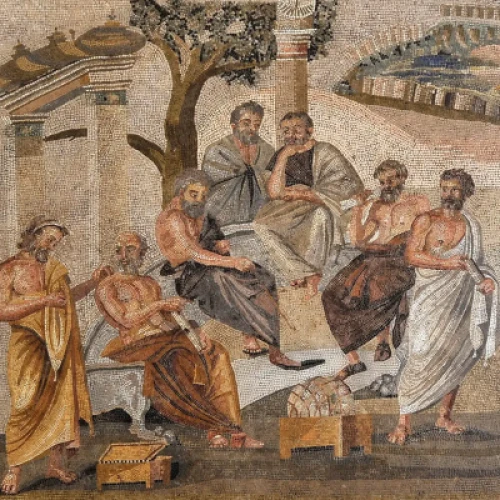
In order to comprehend the reasons for such a high level of influence of the Catechetical School, one needs to be aware of the particular psychological climate of the city in ancient Alexandria. Not being a tranquil rural settlement, the town was a hotbed of philosophical controversy. One had only to walk around the public squares to come across people of different philosophical persuasions, arguing about everything from cosmology to the existence of God and the immortal soul.
Christianity did not have the right to resort to merely emotional methods when entering Alexandria. The educated elite required logical justification of any beliefs and philosophical consistency.
Saint Mark, having understood this, founded the Catechetical School. Its primary purpose was clear enough: to ensure that Christian individuals could successfully argue their case against representatives of the intellectual elite of Rome and show that Christianity was not some sort of ignorance but the highest form of human wisdom.
2. A Radical Curriculum: Blending Science and Spirit
Unlike the modern theological seminaries, which are based solely on the study of sacred scriptures, the Catechetical School of Alexandria followed an incredibly holistic educational approach. The founders of the school were strongly convinced that all truth comes from God, regardless of the form in which it is expressed – whether it is revealed in a scripture passage, a mathematical theorem, or the movements of celestial bodies.
Upon enrollment at the school, the students did not immediately get the Gospel. Instead, they had to undergo extensive study of such subjects as:
Mathematics and Geometry
Astronomy and Physics
Literature and Rhetoric
Philosophy, especially the theories developed by Plato and Aristotle
The understanding of the highest biblical and theological topics was imparted only to those students who had successfully mastered the above-mentioned secular sciences. The key principle guiding the school was the idea that the thorough study of the complex structure of the material world through science makes the mind sharp enough to perceive the mysteries of the Divine Creator.
3. The Giants of the Lecture Hall
The reputation of any prestigious educational establishment is based on the quality of the teaching staff it has. The Alexandrian Catechetical School gathered and educated some of the brightest minds in history.
Pantaenus: The Traveling Philosopher
During the late second century, the head of the school was a person named Pantaenus. Once a philosopher in the Stoic tradition, Pantaenus later embraced Christianity. Bringing into the classroom such rigorous analysis that was common for Stoic thinkers, Pantaenus showed himself to be a man of action who at some point left his chair to go on a mission trip to India. There he delivered to the eastern world the fruits of Alexandrian philosophy.
Clement of Alexandria: The Reconciler
After Pantaenus came his outstanding student Clement of Alexandria. Being an excellent bridge builder, Clement believed that Greek philosophy could not serve as an enemy of Christianity, but rather as a means of preparing people's hearts for receiving the news of salvation in Christ – just as God used the law of Moses to prepare the people of Israel for receiving the Gospel of Christ.
Origen: The Unmatched Scholar
Without a doubt, the most famous, controversial, and most prolific figure to ever hold this post is Origen himself. Taking over the helm from such a young age as only eighteen after his father’s martyrdom, Origen was an intellectual giant. He is said to have kept a team of scribes writing nonstop day and night as he dictated countless volumes of commentaries, treatises, and philosophies.
Origen introduced the theory of scriptural exegesis based on its three levels – literal, allegorical, and spiritual. His ideas went so far beyond human understanding that long after his time, theologians continued discussing his bold cosmological concepts.
4. The Lasting Impact on Global Orthodoxy
The Alexandrian Catechetical School was not some ivory tower where theology was invented. On the contrary, its theological concepts would form the very basis of global Christianity.
As soon as the major ecumenical councils such as the famous Council of Nicaea of 325 were convened for the purposes of settling highly disputable issues in relation to Christology, it was the graduates from the Alexandrian School who were willing to take on their roles as defenders of orthodoxy.
Saints Athanasius the Apostolic and Cyril of Alexandria were products of this rich intellectual legacy, and it was they who would create the exact language and conceptual framework which would guide global Christianity for centuries to come.
5. The Living Continuity: The Modern Coptic Seminary
Even though the original buildings of the early institution crumbled away over time due to the chaotic events that took place in the later years of the Roman Empire, the essence of the Catechetical School never died out. It survived through the actions of the Coptic monks who kept manuscripts safe, transcribed texts, and studied fervently in the isolated monasteries of Egypt.
In 1893, however, the institution saw a magnificent reemergence in the form of the Coptic Theological College which was founded in Cairo. Currently, this institution is considered to be the best seminary school of the entire Coptic Orthodox Church, providing priests with an identical tradition of faith and knowledge that existed thousands of years ago.



-webp.webp "Hilton")
-webp.webp "dusit")
-webp.webp "Marriott Hotels")
-webp.webp "Azimut Hotel")
-webp.webp "Golden Tulip")
-webp.webp "sheraton")
-webp.webp "westin hotel")
-webp.webp "Movenpick")