
-webp.webp)
Step Pyramids and Sacred Spells: A Journey Into the Heart of Saqqara
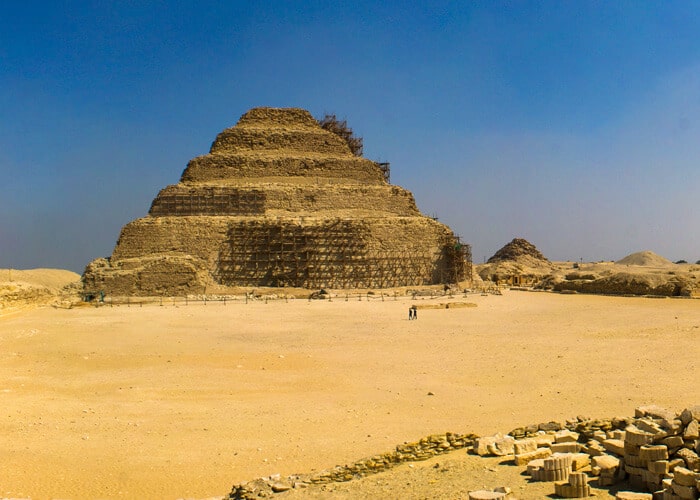
The Sands of Time: Unlocking the Secrets of the Saqqara Necropolis
For most travelers, when they map out a trip to Egypt, their minds kind of stop right away at the Giza Plateau. We tend to picture the three, perfect huge pyramids of Khufu, Khafre, and Menkaure standing there like silent guardians over the desert , their sharp edges cutting clean through the blue sky. It’s an unbelievable sight, but it’s also not really where the whole tale of Egypt’s everlasting tombs started.
If you want the true starting point of monumental stone architecture, you need to go for a drive, roughly 30 kilometers south of Cairo. And there, rising from a wind-worn limestone plateau is Saqqara.
Saqqara itself sprawls across more than six kilometers of desert, and it’s often described as Egypt’s oldest, and also the most historically continuous royal burial ground. It worked as the main cemetery for the ancient capital of Memphis for well over 3,000 years. So yeah, while Giza feels like the grand finale of pyramid building , Saqqara is more like the raw, bright workshop-lab, where ancient Egyptians tested, adjusted, and learned how to build so it would last.
From the world’s earliest stone pyramid , to newly uncovered mummification workshops, let’s take a closer look at the puzzles, the long history , and those genuinely exciting recent discoveries hidden in this sort of underground wonderland.
1. The Step Pyramid of Djoser: Where It All Began
You can’t really talk about Saqqara without mentioning, sort of in the same breath, its crown jewel: the Step Pyramid of Djoser. I mean it’s built, during the Third Dynasty (about 2680 BCE) and it feels like this monument is the literal ancestor of basically every pyramid that came after it.
Before Djoser, kings and nobles were laid to rest in mastabas, those flat rectangular mud-brick tombs that look like oversized benches. Then Djoser’s brilliant vizier and main architect Imhotep shows up with a bold idea. He wanted a tomb made of stone, not this flimsy mud-brick, so he stacks six progressively smaller “mastabas” on top of each other, as if it’s climbing upward, piece by piece.
What you end up seeing is this huge 60-meter-tall stairway, almost reaching for the heavens. Inside, there’s a dizzy network of shafts, passages, and tunnels that dives into the bedrock, pushing you toward the pharaoh’s central burial chamber. And if you stand in front of it today, it kind of hits you that you’re staring at the exact moment monumental stone architecture is born on our planet.
2. The Painted Mastabas: What Most Visitors Miss
While Djoser’s pyramid is basically doing all the work across the skyline, some of Saqqara's real treasures are sort of… not really seen at all. Out in the desert floor, right around those pyramids, there are the mastaba tombs of Old Kingdom high officials and court nobles, tucked in like they don’t want attention.
Now, these nobles, they didn’t exactly have the royal budget for towering stone mountains. So instead, they poured their resources into decorating the interior walls of their burial chambers, which feels a little different, and in a good way.
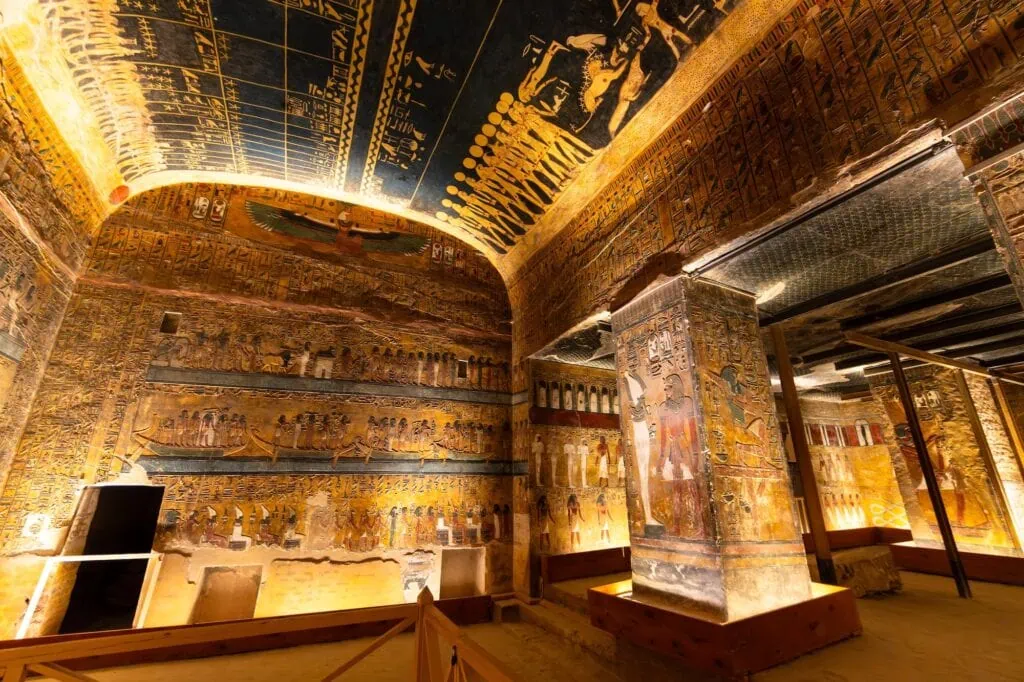
Two of the most extraordinary examples are the Tomb of Mereruka and the Tomb of Ti. When you step inside the limestone rooms, it doesn’t feel much like visiting a dusty grave. It feels more like walking through a vivid ancient comic strip, like someone drew it yesterday but with 4,500 years of patience.
The carvings and painted plaster reliefs are super detailed, and they also look kind of animated. In one scene, a farmer who is kind of tax-avoiding is hauled before a stern judge. In another, a dwarf jeweler threads tiny gemstone beads onto a necklace, slowly and carefully. The colors are made from ground ochre , copper, and charcoal , and they still stay remarkably bright. So you get this close-up, very human view of everyday life along the Nile, over 4,500 years ago.
3. The Necropolis That Never Stops Giving
If you think Egypt’s archaeology is all ancient history, kind of move on, because Saqqara is in the middle of this really busy , really productive, honestly kind of electric archaeological moment.
In the last few years, Egyptian and international missions have been pulling hundreds of amazing finds out of the deep sands, and it’s not subtle at all.
Mummification Workshops: archaeologists uncovered a huge state-of-the-art embalming set-up. There were clay mixing bowls, measuring cups ,and also specialized storage jars. It’s basically a whole workstation, and it has helped scientists pin down the precise chemical recipes—like the oils and imported resins—used to preserve human bodies for the afterlife.
The Cache of Anthropoid Sarcophagi: teams have brought to light hundreds of beautifully painted, intact wooden coffins, most connected to the Late and Ptolemaic periods. A lot of these mummies were found completely undisturbed, still wearing their bright golden funerary masks, like they were paused for a moment.
The Second and Third Dynasty Tombs: just recently, an Egyptian-Japanese team uncovered several fresh tombs along with mud-brick mastabas. That’s the point here: it shows the northern edge of the Saqqara plateau was used as a sacred burial zone far earlier, and for a longer span, than anyone had mapped before.
4. The Spiritual Powerhouse: The Pyramid Texts
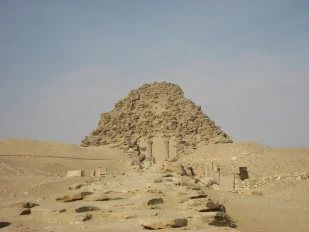
If you walk a bit south of the main Step Pyramid complex, you’ll spot the ruined, crumbling pyramid of Pharaoh Unas (Fifth Dynasty). From the outside it really looks like not much more than a pile of rubble, sort of pushed together in a tired way.
Yet once you step inside, you get met by one of the most sacred chambers in all of human history, honestly it feels different immediately.
The walls in Unas’s burial chamber are carved, from floor to ceiling, with a whole set of star patterned ceilings along with rows of delicate blue-green hieroglyphs. And yeah, these are the Pyramid Texts—the earliest religious writings and funerary spells ever found on Earth.
Those spells basically worked like a magical GPS for the dead pharaoh. They held prayers, incantations and protective rites, made to help the king move through the treacherous underworld, full of demons and dark passages, then climb toward the night sky and become an immortal star. Standing there in those quiet rooms, looking at the old carved characters, is incredibly powerful, and also kind of haunting in a way that stays with you.
5. Practical Guide to Visiting Saqqara
Since Saqqara is this enormous, spread out archaeological place, a good visit really needs some “ok plan it first” energy:
Beat the Heat and the Crowds: the site officially starts at 08:00 AM. If you show up right when it opens, you can wander through the open air Step Pyramid area in near quiet, before the tour buses start rolling in around 10:00 AM.
Budgeting for Entry: the basic entry ticket usually includes the big outdoor spaces and Djoser’s complex. But a few of the most amazing indoor or half indoor spots—like the Serapeum (the underground resting place of the sacred Apis Bulls), the Tomb of Mereruka, and the Southern Tomb—need extra add on tickets, specialized ones.
Secure Tour Bookings: Saqqara often feels way easier when you have a private, licensed Egyptologist guiding you. They can read the hieroglyphs and also help you not get lost in all that sprawling layout.
For custom day trips from Cairo, always double check for trusted operators who use secure checkout systems, like WeTravel, or payment routes backed by Stripe. That way your card details stay encrypted with PCI-DSS Level 1 practices, so your financial info stays protected while you’re out there enjoying the desert adventure.




-webp.webp "Hilton")
-webp.webp "dusit")
-webp.webp "Marriott Hotels")
-webp.webp "Azimut Hotel")
-webp.webp "Golden Tulip")
-webp.webp "sheraton")
-webp.webp "westin hotel")
-webp.webp "Movenpick")