
Pyramids of the Fourth Dynasty of Egypt: The Golden Age of Pyramid Building
Introduction
Indeed, the Fourth Dynasty of Ancient Egypt is commonly seen as the pinnacle period of pyramid construction. In this wonderful era of the Old Kingdom, some of the most astounding buildings were erected by Egyptian architects, engineers, and builders. The pyramids of the Fourth Dynasty not only changed the Egyptian landscape dramatically but set architectural standards that are still breathtaking for today’s archaeologists and tourists.
Whenever one imagines ancient Egypt, he thinks of the gigantic pyramids at Giza. This is what was left from the Fourth Dynasty – the time of prosperity, stability, and innovations. The kings of the dynasty spent tremendous money on building magnificent burial constructions to show their godlike power forever.
The Fourth Dynasty and the Rise of Monumental Architecture
The Fourth Dynasty is known to have governed Egypt in the Old Kingdom era, ranging from 2613 BCE to 2494 BCE. The Fourth Dynasty can be described as the pinnacle of pyramid construction since it saw the erection of some of the largest and most complex pyramids.
Contrary to previous dynasties that were still exploring various designs for tombs, this dynasty perfected the concept of pyramid architecture through its advancements in engineering, stone masonry, and labor management skills.
Several notable pharaohs emerged from the Fourth Dynasty, whose legacies have stood the test of time in Egyptian history.
Pharaoh Sneferu: The Father of Pyramid Construction
History of the Fourth Dynasty Pyramids starts with King Sneferu who was one of the best rulers in Egyptian history. This period was marked by architectural revolution because Sneferu built several pyramids, which contributed greatly to pyramid architecture advancement.
King Sneferu used new construction methods for pyramid buildings, and therefore his engineers invented and developed new engineering methods and skills, which enabled future kings of Fourth Dynasty to construct their pyramids.
Most scientists consider Sneferu the founder of classical pyramid building because his pyramids introduced principles of pyramid architecture.
The Meidum Pyramid
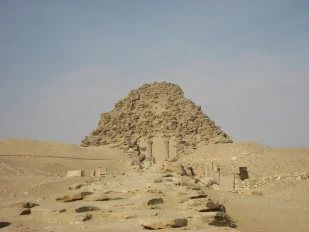
Among the earliest and significant projects connected with Sneferu is the Meidum Pyramid. The construction started off as a step pyramid but was later adjusted into having smooth sides, thus showing the transition to the form of classic pyramids.
In spite of the partial collapse of the pyramid's casing, it still serves as one of the most remarkable examples of experimenting with pyramid construction by Egyptian architects. Archaeologists regard it as a crucial moment in the development of the Egyptian monumental buildings.
The Meidum Pyramid shows the readiness of Fourth Dynasty builders to experiment and improve the old architectural techniques.
The Bent Pyramid
The Bent Pyramid is considered as one of the most extraordinary structures in the history of ancient Egypt. It has such an unusual form because of the change of the building angles halfway up the pyramid.
The bottom part rises steeply while the top of it grows slowly in accordance with the angle. Such a structure helps us understand better the problems of ancient Egyptian constructors and engineers in creating their constructions.
Presently, the Bent Pyramid represents one of the best preserved pyramids in Egypt.
The Red Pyramid
The Red Pyramid symbolizes the apex of the architectural feats of Sneferu. It lies near the Bent Pyramid of Dahshur and is regarded as the first successful true pyramid in Egypt.
The Red Pyramid has an even shape, which would serve as the template for future pyramids. The red appearance of the Red Pyramid comes from the red limestone that was used to build it.
The Red Pyramid symbolizes the advancements that were made during the reign of Sneferu, and it paved the way for the Great Pyramids of Giza.
Khufu and the Great Pyramid of Giza
There is no doubt that the most renowned Fourth Dynasty monument is the Great Pyramid at Giza which was erected for King Khufu. It was erected circa 2560 BC and represents an unparalleled engineering accomplishment of ancient times.
The Great Pyramid had a height of approximately 146 meters and held the record as the world’s tallest human construction for close to four thousand years. The pyramid consisted of 2.3 million stone blocks and was an awe-inspiring sight to behold.
Its perfection, size, and design clearly reflect the advanced engineering skills of the Fourth Dynasty craftsmen and engineers.
The Construction Mystery
The aspect of construction of the Great Pyramid, which makes it fascinating for study, includes questions regarding its construction process. Researchers have been engaged for many years in exploring the ways of transportation, lifting, and positioning of thousands of blocks of stones with exceptional precision.
It has been proven that it was not slave labor but an efficiently organized team of workers who performed the construction work. Workers lived in the neighboring villages, where they were supplied with food and various kinds of aid by the state.
The project proves the organizational efficiency and prosperity of the Fourth Dynasty.
Pharaoh Khafre and the Second Pyramid
The successor of Khufu, Pharaoh Khafre, maintained the tradition of grand-scale construction in his dynasty through the construction of the second largest pyramid located in Giza.
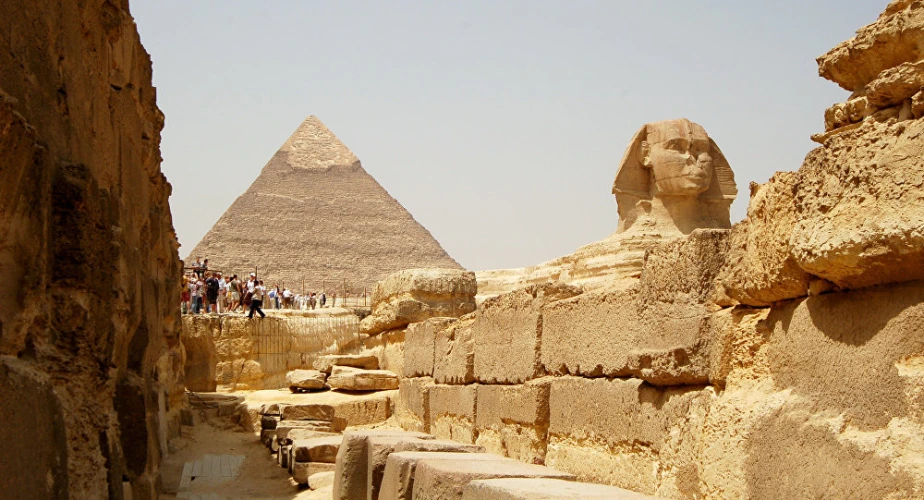
While being smaller than the Great Pyramid, Khafre’s Pyramid actually looks taller due to its location on a higher elevation. Some parts of the original limestone covering of the pyramid can still be seen on top.
Khafre’s complex is home to another very famous Egyptian monument, the Great Sphinx.
The Great Sphinx of Giza
It is said that the construction of the Great Sphinx dates back to the time of Khafre's rule. Made of a single rock formation of limestone, the monument consists of the body of a lion and the head of a pharaoh.
This monument has intrigued travelers, historians, and archaeologists for decades and even centuries due to its purpose, meaning, and original image.
One can say that, along with Khafre's Pyramid, the Sphinx makes an extraordinary archaeological landscape on our planet.
Menkaure and the Third Pyramid
The last significant pyramid in Giza is the one built for Menkaure. This pyramid may not be as grandiose as the pyramids of Khufu and Khafre but it still stands out as one of the most outstanding structures constructed by ancient engineers.
The pyramid built for Menkaure represents a new trend of constructing smaller monuments, but still with the highest level of quality that had been achieved before. The structure was initially covered with expensive materials like granite and limestone.
The complex itself included several other structures such as temples and statues.
Why the Fourth Dynasty Pyramids Are So Important
Not only do the pyramids of the Fourth Dynasty serve as tombs for pharaohs; they are indicative of Egypt’s success in political strength, economic wealth, and technical ability during this period.
Such monuments provide evidence that when a strong central government works together with highly skilled people, monumental achievements can be attained. The impact of these pyramids cannot be confined to Egypt because they have inspired many others after them.
The Fourth Dynasty pyramids continue to be one of the most researched monuments in the world.
Visiting the Fourth Dynasty Pyramids Today
There is no dearth of such monuments that were constructed by the Egyptians in the Fourth Dynasty and that continue to awe the modern tourist. The Giza Plateau remains popular among tourists who flock there by the millions. However, those seeking a more secluded experience can visit the pyramids at Dahshur and Meidum.
Such visits are bound to offer the visitor the unique experience of observing the evolution of pyramid construction from its inception until it reached perfection. These monuments remain among the most amazing structures ever conceived and constructed in the history of civilization.
Conclusion
Pyramids of Egypt from the Fourth Dynasty represent one of the most amazing creations by humans that reflect ambition, imagination, and engineering capabilities. With the inspiration of the likes of Sneferu, Khufu, Khafre, and Menkaure, Egypt created structures that still impress people more than four thousand years after their creation.
The contribution of the Fourth Dynasty is reflected by such constructions as Bent Pyramid and the Great Pyramid of Giza. They have left their mark not only on the face of Egypt but also on humanity as well.




-webp.webp "Hilton")
-webp.webp "dusit")
-webp.webp "Marriott Hotels")
-webp.webp "Azimut Hotel")
-webp.webp "Golden Tulip")
-webp.webp "sheraton")
-webp.webp "westin hotel")
-webp.webp "Movenpick")