


Khufu: The Pharaoh Who Built the Great Pyramid of Giza
Introduction
Khufu is considered to be one of the most famous pharaohs in the history of Ancient Egypt, having built the world-famous Great Pyramid of Giza. Despite his distant origin in time, which goes back more than 4,500 years, his name continues to be well-known all over the planet thanks to the remarkable architectural feat attributed to him. Not only does the Great Pyramid stand out as the biggest pyramid ever built in Egypt, but it is also the sole witness to wonders of the Ancient World.
Nevertheless, although Khufu became an internationally famous figure, very few facts about his personal life have been preserved.
Who Was Khufu?
Khufu was the second ruler of Egypt's Fourth Dynasty in the Old Kingdom Period. He ruled from 2589-2566 BC, during the period of golden age when pyramids were built. He was a son of Sneferu, who was the most renowned of all kings in Egypt for constructing buildings, and Queen Hetepheres I.
When he became the king, Khufu was extremely fortunate, as he came to rule an affluent state because of prosperity under his father's reign. At that time, Egypt was a politically stable and economically prosperous nation, possessing plenty of natural resources, which enabled Khufu to construct his great pyramid.
The original Egyptian name of Khufu was Khnum Khufu, signifying “Khnum protects me,” where Khnum is the name of the ram-headed god of creation.
Khufu's Rise to Power
Khufu was the second ruler of Egypt's Fourth Dynasty in the Old Kingdom Period. He ruled from 2589-2566 BC, during the period of golden age when pyramids were built. He was a son of Sneferu, who was the most renowned of all kings in Egypt for constructing buildings, and Queen Hetepheres I.
When he became the king, Khufu was extremely fortunate, as he came to rule an affluent state because of prosperity under his father's reign. At that time, Egypt was a politically stable and economically prosperous nation, possessing plenty of natural resources, which enabled Khufu to construct his great pyramid.
The original Egyptian name of Khufu was Khnum Khufu, signifying “Khnum protects me,” where Khnum is the name of the ram-headed god of creation.
The Great Pyramid of Giza
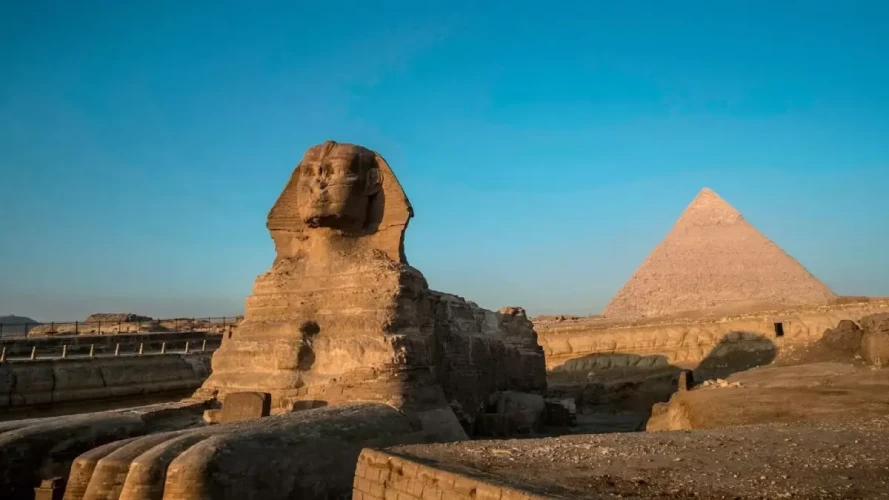
However, Khufu's main contribution lies with his Great Pyramid located at the Giza Plateau, near the modern city of Cairo. This was the royal tomb of Khufu and one of the most impressive monuments that have been constructed.
The height of the pyramid was about 146 meters (481 feet), making it the highest building of man's construction for close to four millennia. Building such a pyramid demanded great efforts and knowledge of engineering, and a well-planned process of work.
The Great Pyramid consists of 2.3 million blocks of stones that often weigh several tons each. Till now, scientists keep trying to understand how ancient Egyptians managed to place the stones precisely.
The Great Pyramid attracts thousands of tourists every year.
How the Great Pyramid Was Built
One of the most intriguing riddles throughout history is the creation of the Great Pyramid. Current investigations indicate that professionals rather than slaves erected the pyramid.
Archaeologists uncovered worker camps, bakeries, hospitals, and dwellings near the Giza Plateau. These discoveries imply that the workforce was well-organized and backed up by the government.
A group of workers mined limestone, moved huge stones, and constructed the pyramid following a preconceived plan. Despite disagreements among historians regarding the methods of construction, it is evident that a great deal of organization went into this project.
The construction of the Great Pyramid proves the abilities of ancient Egypt under Khufu's rule.
Khufu's Pyramid Complex
The Great Pyramid was just a small portion of a large funerary complex built to facilitate Khufu's passage to the afterlife.
Some other parts of the complex included temples, other smaller pyramids belonging to Khufu's relatives, and causeways joining various parts of the complex. It is worth noting that the ancient Egyptians believed that these structures would help Khufu gain immortality among the gods.
Among many interesting discoveries linked with the funerary complex is the Khufu Ship. It was discovered near the great pyramid and was used for the purpose of helping the pharaoh during his journey in the afterlife.
It is amazing how well preserved the wooden ship is because it helps us understand more about the ancient Egyptians.
Khufu's Family
Belonging to one of the most powerful royal clans in Egypt, Khufu was a descendant of Sneferu who had constructed several pyramids and laid down the foundations of pyramid architecture.
Khufu himself was married to several women and had a few offspring. He was succeeded by another ruler from the same family whose contribution includes building the second biggest pyramid in the Giza area. This ruler is usually credited for building the Great Sphinx as well. His other successor, Menkaure, constructed the smallest of all three pyramids in Giza.
Through their contributions, these monarchs laid down the foundation of the Giza Pyramid complex which attracts millions of tourists even today.
Historical Accounts of Khufu
Historians from Ancient Greece, especially Herodotus, wrote about Khufu many years after he died. In their narratives, some depicted him as a cruel leader who allocated huge amounts of money for the construction of his pyramid.
But modern-day historians do not take these narrations seriously since they were composed long after the era of Khufu.
Archaeological findings give an objective depiction. These have revealed that Khufu ruled a very organized kingdom where he was able to undertake big projects without disrupting its stability.
Though much is still not known about Khufu, his accomplishments prove to us that he was indeed an extraordinary leader.
Khufu's Legacy
Very few individuals in the history of the world have created such a legacy that is still remembered today. Khufu is certainly one of them, whose Great Pyramid is regarded as one of the greatest architectural feats ever created by man.
Many experts in the field of archaeology and architecture have researched the building in order to find out how it was erected. Over time, the pyramid has become a representation of both ancient Egypt and the intelligence and strength of the human spirit.
The rule of Khufu marks the pinnacle of the power of Egypt's Old Kingdom era as well as the golden age of the pyramid era.
Visiting Khufu's Pyramid Today
The Great Pyramid of Giza is one of the most visited sites anywhere in the world. Millions of people from across the world visit Egypt just for the purpose of seeing the pyramid and experiencing its size.
A tour of the Giza Plateau provides visitors with the chance to study the architectural genius that went into building the pyramid and gain insight into the civilization and beliefs that led to its creation.
After more than 4,500 years since its construction, the Great Pyramid stands as an enduring symbol of the great pharaoh whose name will forever be associated with the word "great."
Conclusion
Khufu is considered to be one of the greatest pharaohs in ancient Egypt. The fact that he was responsible for the construction of the Great Pyramid of Giza makes him even more memorable.
Not many things are known about the life of Khufu, but it is clear that his accomplishments were great. The Great Pyramid serves as evidence of the creativity, skill, and resourcefulness of Egyptians from the time of the Fourth Dynasty. Due to this magnificent work of architecture, Khufu has become a truly legendary ruler.



-webp.webp "Hilton")
-webp.webp "dusit")
-webp.webp "Marriott Hotels")
-webp.webp "Azimut Hotel")
-webp.webp "Golden Tulip")
-webp.webp "sheraton")
-webp.webp "westin hotel")
-webp.webp "Movenpick")
