
-webp.webp)
From Caliphs to Mangoes: The Thousand-Year Evolution of Egyptian Kunafa
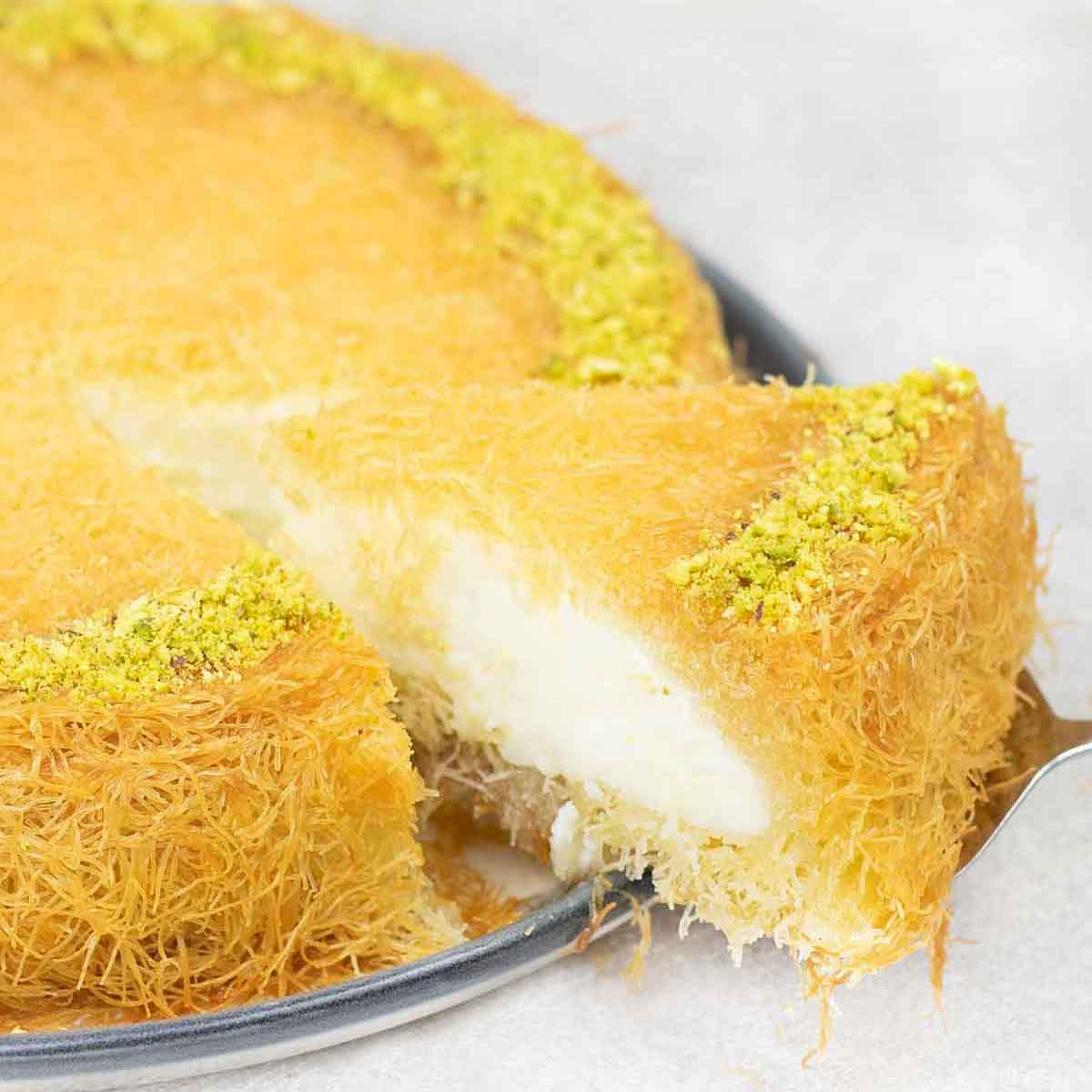
Golden Threads of Heaven: Why Kunafa Is Egypt’s Most Loved Dessert
If you ever end up walking through the storied, kind of maze-like lanes of Islamic Cairo in Ramadan, you might catch this amazing street-side culinary show that… honestly, looks pretty much the same as it did ages ago.
Right there, in front of you, a huge, blazing-hot circular copper hotplate is waiting. Beside it stands the Kanafany, the sweetness master, the traditional craftsman. He has in his grip a heavy cup, metal and multi-spouted, filled with a smooth, velvet-like batter made from flour. Then, with this flowing, almost trance-like swing of his arm, he spreads the mixture over the hissing copper. In what feels like only a few heartbeats, the liquid turns into thousands of whisper-thin, delicate, lacey golden strands. After that, he lifts them up in one practiced movement, gathering and stacking them as if they’re soft, edible silk.
This is where Kunafa (koo-NAH-fa) really begins.
And even though Egypt has an absolutely wild range of classic desserts—from the syrup-soaked semolina Basbousa, to the cozy, flaky puff pastry of Om Ali—Kunafa still stays, without much debate, on the highest rung of the Egyptian dessert kingdom. It is not just some little sweet afterward. It’s a cultural wave, a sign that a season is here, and also a kind of culinary time capsule, holding the shared memories of an entire country.
Maybe you get it the traditional way, with that satisfying crunch and nuts tucked inside. Or maybe it comes remixed, with bold modern ideas like fresh mango, or lotus cream. Either way, Kunafa feels like that edible burst of happiness, indulgence, and real human warmth that Egypt seems to do so well.
So, in this deep dive, made by humans, we’ll wander through the royal beginnings of this spun-sugar story, the careful craft behind its structural crispness, the big modern flavor shift, and exactly why this dessert keeps such a strong, ironclad hold on the hearts of the Egyptian people.
1. Sweets for the Caliph: The Royal and Healing History of Kunafa
Like lots of Egypt’s most famous dishes, Kunafa is kinda wrapped in colorful historical folklore that goes back, more than a thousand years or so. Even though food historians still argue, very passionately about where it was born exactly, the most loved Egyptian version says the dessert shows up in the 10th century, during the shining Fatimid Dynasty.
In the story, the imperial doctors in the royal court got hit with a real problem. The ruling Caliph, Muizz li-Din Allah (or, in some retellings, the well known Umayyad Caliph Muawiyah from centuries earlier) was struggling a lot with the hard physical load of fasting, during the daylight hours of Ramadan. He needed something for Suhoor, the pre-dawn meal, that felt deeply satisfying , loaded with steady energy, and good at holding back those hunger pangs all the way through the long hot desert days.
So the court confectioners got busy, and they created a rich structural kind of dish, made from spun wheat threads, soaked in pure clarified butter, samna, filled with nuts, and then sealed with a thick blanket of sweet sugar syrup glaze. The Caliph drank it in, liked it immediately, and basically made it through his fasts with ease.
After that, Kunafa turned into a royal luxury. For generations it stayed a delicacy for elite courts, only rulers and nobles could enjoy it. But over time the recipe slipped out of the imperial palace gates, onto Cairo’s loud and living streets, where regular people took it, improved it, and made it into the clear national tradition it is today.
2. The Anatomy of Textural Perfection: The Classic Kunafa
To understand the genius of Kunafa, you sorta have to look at it from the structural engineering side. The baseline of the dessert kind of relies on two simple elements: texture and saturation, thats basically it.
The foundation is the Kanafani threads (also called Katalfa or shredded phyllo dough). To make a classic Egyptian Kunafa (Kunafa bil-Maksarat), the chef takes this whole mountain of raw, pliable pastry threads and tears them up , or chops them into fine, uniform bits. Then they soak the pastry in an absolute lake of melted, warm Egyptian ghee. This part is crucial; every microscopic strand of dough needs to be completely coated in butter so that, when it goes into the oven, it goes through a perfect, uniform Maillard reaction. That’s what gets you the deeply satisfying, shatteringly crisp golden-brown, like you can hear it.
The Traditional Stuffing and the Sharbat Ritual
The buttered dough is split into two halves. One half gets pressed firmly into the bottom of a heavy round aluminum pan, building this dense interlocking crust. Then the chef scatters the traditional filling across the top, a generous mix of crushed walnuts, hazelnuts, almonds sweet raisins, and a heavy dusting of desiccated coconut. The remaining dough is laid on top and pressed down hard, using a smaller pan, to lock the layers together.
After baking until it reaches that flawless golden hue, the dramatic climax happens: the Sharbat (or Aasl) gets introduced. This is a thick, cold sugar syrup, sometimes with a hint of lemon juice, rosewater, or orange blossom water.
The cold syrup is poured straight over the screaming-hot, freshly baked Kunafa. The pastry absorbs it with this fierce crackling hiss, instantly pulling the sweetness deep into its core while the outer crust stays brilliant and crunchy, still keeping that snap. It’s a brilliant little study in mouthfeel, and honestly the whole thing kinda works like a system… not just dessert.
3. The Modern Revolution: Mangoes, Nutella, and the Ramadan Turf War
While the classic nut-stuffed Kunafa still feels like this cozy old memory, Egypt’s pastry vibe is far from just sitting still. Over the last twenty years, Kunafa has sort of become, like the blank canvas for one of the most imaginative, high-pressure, and honestly wildly delicious modern food revolutions across the Middle East.
Every year, when Ramadan starts getting close, Egypt’s top confectionery houses—like El Abd, Tseppas, and Mandarine Koueider—basically jump into this loud, very public creative contest, to see who can pull off the most unreal , decadent twist on Kunafa.
Kunafa bil-Manza (The Mango Crown Jewel)
The unquestionable star of the newer versions is Mango Kunafa. It was truly shaped during summer Ramadans, when Egypt’s famous extra-sweet mangoes are in full swing, peak ripeness. Instead of the usual baked structure, it swaps in crispy golden-fried Kunafa strands, which are then crushed into a loose crumble. That crunchy bottom sits inside big glass bowls, with alternating layers of thick silky pastry cream, fresh whipped cream, and then this pile—like a small mountain—of juicy Egyptian mango cubes. It’s served cold, tastes super refreshing, stays light and it ends up feeling like a full-on national obsession, every single time.
The Contemporary Cast
Step in to a modern Cairo dessert shop today, and you’ll see Kunafa getting pushed to this sort of creative limit, like it cant really stop. Really, it’s kind of like watching the whole thing evolve in real time
Lotus Biscoff & Nutella Kunafa: it comes with those crispy pastry layers, then they get soaked in melted cookie butter or maybe a deep hazelnut chocolate, depending on what you grab.
Kunafa bil-Qashta: this classic Levantine mood, where the middle is packed with a thick, unsalted clotted cream, and when it hits the warm crust it just kind of melts into everything in a really soft way.
Red Velvet and Cheesecake Kunafa: a bit wild, more than one culture in one bite, it blends Western style plating with that Middle Eastern crunch, so it feels both familiar and strange at the same time.
Insider Tips for the Culinary Traveler
Seek Out the “Khishnah” vs. “Na’amah” thing: When you’re ordering Kunafa in those old school shops , they may ask you if you want it Khishnah (coarse) or Na’amah (smooth). Khishnah is basically the classic crunchy shredded strands, while Na’amah leans on a finely ground, sand-like bulgur or flour layer, so you get a denser bite that melts more quickly. Both are really something , but honestly Khishnah tends to give you that iconic snap, like the best kind of crunch .
The Unsweetened Mint Tea Rule: Since real Kunafa is kind of unashamedly rich, sweet, and totally soaked in ghee plus sugar syrup, having it with a sugary soda or sweet juice can suddenly make everything feel too much. Do what the locals do: take your piece of hot Kunafa and pair it with a hot glass of Egyptian black tea , brewed with fresh mint leaves, but don’t add sugar. That clean , bitter , refreshing profile cuts through the sweetness , and it also kind of resets your mouth for the next bite.
The Ramadan Phenomenon: Sure, Kunafa shows up year-round, but trying it during Ramadan feels like a whole different spiritual , human moment. At night the pastry places are buzzing, the line can stretch way down the block, and the options keep coming—like endless variations of “just one more.” It’s more than dessert, it’s the food of community, sharing, and that late-night togetherness vibe.




-webp.webp "Hilton")
-webp.webp "dusit")
-webp.webp "Marriott Hotels")
-webp.webp "Azimut Hotel")
-webp.webp "Golden Tulip")
-webp.webp "sheraton")
-webp.webp "westin hotel")
-webp.webp "Movenpick")