
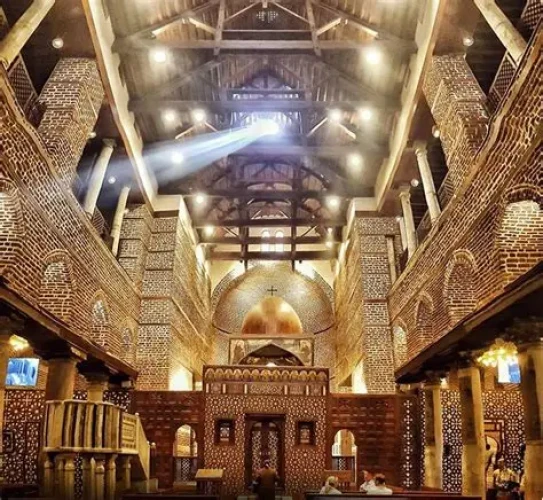
Before the Pyramids: The Untold Story of Prehistoric Egypt
.jpg)
The Deepest Roots: When Early Hunters Ranged Across a Fertile Egypt
The Palaeolithic Period. The earliest indications of man in the Nile Valley are in the lower sands and gravels of the 30m wadi and river terraces of Upper Egypt and Nubia, dated c 250,000 BC. Primitive hand-axes, flakes and cores were used, similar to those found in Europe in the Lower Palaeolithic. At this time the whole of North Africa was habitable and hunters ranged over a wide area.
The Great Aridity: How a Shifting Climate Forced Humanity to the Nile
Towards the end of the period, c 25,000 BC, the climate underwent a drastic change and the grass steppes turned to desert, causing early man to withdraw towards sources of water, either in the oases or in the Nile Valley.
The Sebilian Culture: Echoes of Daily Life from Ancient Kitchen
This later culture, known as the Sebilian from its type-station near cAzbat al-Sabll in the Korn Ombo Basin, was centred in Upper Egypt and Nubia close to the Nile. By the Upper Sebilian period (16,000-10,000 BC), the Nile bed had sunk about 3m below its present level, due to increasing aridity. The kitchen middens of the people of this period contain broken and charred animal bones, freshwater shells and stone pounders and grinders. Other Late Palaeolithic sites have been found on the edge of the Eastern Delta, at Abu Suwayr, Shibin al-Qanatir near the Isma-91iyyah Canal, and at Heliopolis, near Cairo, while Khargah Oasis, in the Western Desert, has also yielded remains. At Korn Ombo and Qaw human bones were found among those of animals. The fauna included both riverine and desert types, the Cave hyena ( Crocuta hyaena
subsp.), lions (Pelis leo subsp.), wild horses and asses (Equus spp.) hippopotami (Hippopotamus), pigs (Sus) and short- and long-horned oxen (Bos spp.). Many animals then found in the Egyptian area now only occur further S in Africa or have become extinct.
The Mesolithic Wanderers: Isolated Tribes and Forgotten Rock Art
The Mesolithic Period (10,000-5000 BC). The population of Egypt at this time comprised a number of different groups of semi-nomadic fishers and hunters who lived in comparative isolation one from another. One of the earliest sites was found in 18'11 at Halwan near Cairo and this has marked links with the well-established Natufian culture of Palestine and Syria. Similar finds have been made near in Upper Egypt. The blade industries missing from the Upper NEOLITHIC PERIOD 17 Palaeolithic became common. Other Mesolithic sites are known from Wadi Angabiyyah, called al-CUmari after its finder, and also from the FayYiim. It is possible that the last survivors of these hunting bands were the men who executed rock-carvings in the cliffs overlooking the Nile Valley I
and in the wadi beds leading to the Red Sea, in Nubia and Upper Egypt.
The Neolithic Revolution: How Agriculture and Weaving Reaped New·
The Neolithic Period provides the first positive evidence of the growing of cereal crops. Settlements have been found in the Fayyiim on the edge of the Western Desert, strung out along the side of the lake, from Dimay to Korn Aushim, and also in Middle Egypt. It has not so far been suggested that Egypt was a major source of the cultivation of plants or of the domestication of animals. The most important species of both categories seem to have been introduced from Western Asia. Climatic conditions improved in the 6 rnillenium BC, and a moist interval probably facilitated agriculture and stock breeding. Fishing was also an important part of these early farmers' economy as harpoons and fish spears have been found. Their huts seem to have been mere primitive windbreaks, of which only the post holes survive along with the ashes of their hearth fires. Weaving was practised-linen and flax have been found, as well as spindle whorls. Pottery was already in use and most tools and weapons were of flint. Wild game appears to have been abundant and included hippopotarni (Hippopotamus),
elephant (Loxodonta), wild pig (Sus) and goat (Capra). Paradoxically, the earliest settlements in the Fayyiirn (Fayyfun A) seem to have been more agriculturally advanced than the later Fayyiirn B people who reverted primarily to hunting and fishing, probably for climatic reasons. Settlements in the oases of Siwah and Khargah have close affinities with these people.
Merimda and Maadi: The Rise of Egypt’s First Mega-Settlements
After 5000 BC there was a settlement, at Merimda Bani Salarnah in the Western Delta, ranking as one of the largest prehistoric settlements in Egypt. It occupied an area of some 2 sq. km with a population of about 16,000. A radio-carbon date has given c 4130 BC for the early level, although this method of dating in Egypt has not proved entirely satisfactory. Other settlements have been found atal-CUrnari andatal-Macadi, now a suburb of Cairo. The latter was defended by a stout palisade, while in the cemeteries bodies were buried in a characteristic contracted position. There are marked cultural links between these people and the early Chalcolithic people of Southern Palestine. Palettes, so typical of later Predynastic settlers, were already in use. Much work remains to be done on Egyptian prehistory as attention has mainly been focused on the more remunerative historic periods.



-webp.webp "Hilton")
-webp.webp "dusit")
-webp.webp "Marriott Hotels")
-webp.webp "Azimut Hotel")
-webp.webp "Golden Tulip")
-webp.webp "sheraton")
-webp.webp "westin hotel")
-webp.webp "Movenpick")