


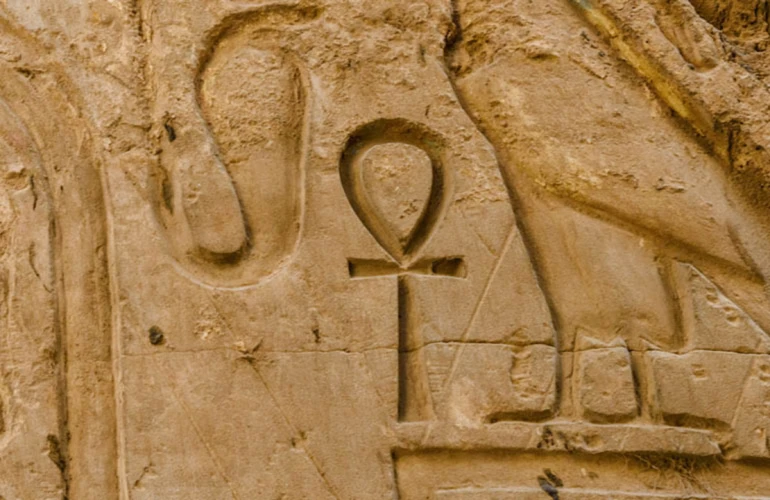
Ankh vs. Cross: Understanding the Origins of the Eternal Life Symbol
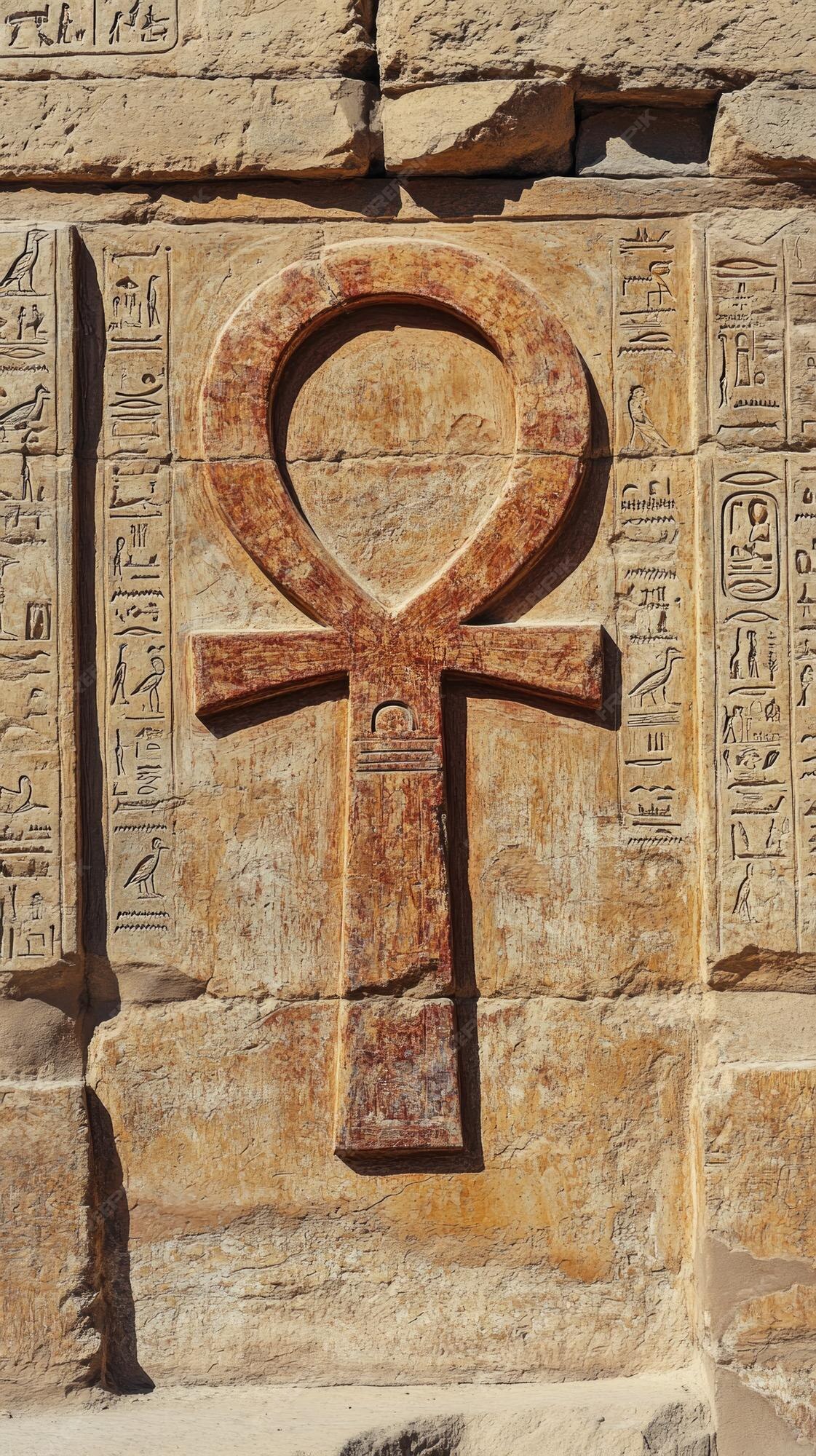
The Ankh and the Cross: at a glance, they are siblings in the family tree of human symbols. Both are composed of intersecting lines that point toward the heavens and out to the horizon. Both are synonymous with the word "eternity." But if you are walking through the streets of Old Cairo in 2026, you’ll notice that these two shapes often live side-by-side, blurring the lines between ancient paganism and modern faith.
While the world often sees them as distinct—one belonging to the Pharaohs and the other to the Church—their history is not one of replacement, but of evolution. To understand the difference is to understand the soul of Egypt itself.
1. The Ankh: Life as a Gift
As we’ve explored, the Ankh is the "Key of Life." In the ancient Egyptian mindset, life was a continuous, cyclical force. It was the "breath" (ankh) that the gods bestowed upon humanity.
-
Source: The Ankh was a symbol of Vitality. It represented the sun, the Nile, and the reproductive union that kept the world turning.
-
The "Handled" Nature: Unlike the Christian cross, which was an instrument of execution, the Ankh was designed to be carried. It was a tool of the gods, a portable battery of divine power.
-
Non-Sacrificial: In the Pharaonic era, eternal life wasn't something you "earned" through suffering; it was a birthright of the cosmos, maintained by rituals and Ma'at (balance).
2. The Cross: Life Through Sacrifice
The Christian cross (the Stauros) entered history with a much darker origin. It was a Roman device for the most painful and shameful of deaths.
-
Source: The Cross is a symbol of Redemption. It represents a specific, linear historical event: the death and resurrection of Jesus Christ.
-
The "Victory" Nature: For early Christians, wearing or displaying the cross was an act of defiance. It turned a symbol of defeat into a symbol of victory over death.
-
The Path of the Soul: While the Ankh was about the breath of life, the Cross was about the sacrifice required to achieve life everlasting. It shifted the focus from the cyclical nature of the Nile to a singular event of salvation.
3. The Bridge: The Birth of the "Crux Ansata"
The most fascinating part of this mystery happens in the 4th century AD. As Christianity began to sweep through Egypt, the early Egyptian Christians (the Copts) didn't simply throw away the Ankh. They recognized it.
-
The Visual Baptism: The Copts saw the Ankh as a "pre-figuration" of the Cross. They adopted the symbol, slightly rounding the loop and calling it the Crux Ansata (the Handled Cross).
-
The Strategy of Conversion: Early missionaries in Egypt used a brilliant "humanized" argument: they told the locals that their ancestors had been holding the Ankh for millennia in anticipation of the true "Key of Life" that Christ would eventually bring.
-
Seamless Transition: This is why, in many 5th and 6th-century Coptic churches in Upper Egypt, you will see the Ankh and the Cross carved on the same stone. To the Coptic eye, the Ankh was the "shadow" and the Cross was the "light."
4. Key Differences: At a Glance
| Feature | The Egyptian Ankh | The Christian Cross |
| Origin Date | c. 3000 BCE | c. 1st - 4th Century CE |
| Core Meaning | General Vitality & Breath. | Specific Salvation & Sacrifice. |
| Shape Focus | The Loop (Infinity/The Sun). | The Intersection (The Human/Divine meeting). |
| Historical Context | A royal/divine scepter. | A Roman execution stake. |
| 2026 Status | Cultural Identity & "New Age" spirituality. | Central emblem of the Christian faith. |
5. Why the "Ankh-Cross" Still Matters Today
In 2026, the "Crux Ansata" remains the primary symbol of the Coptic Orthodox Church. It is a rare example of a "pagan" symbol that was successfully "baptized" into a world religion without losing its original power.
-
Cultural Pride: For many modern Egyptians, the Ankh-Cross represents a "double heritage." It says, "I am a Christian, but I am also a child of the Pharaohs." It refuses to choose between the history of the land and the faith of the heart.
-
The Iconography: If you visit the Coptic Museum in Cairo this year, look for the textiles. You will see the Ankh woven into the patterns of ancient priestly robes, serving as a visual bridge that allowed a nation to change its religion without losing its identity.
6. The Human Truth: A Search for the "Forever"
Whether someone wears an Ankh or a Cross, the human impulse is identical. It is an acknowledgment that the "here and now" isn't enough.
-
The Ankh says: "Life is a beautiful, eternal circle, and I want to be part of the rhythm."
-
The Cross says: "Life is a journey through struggle toward a promised home, and I want to follow the path."
One is about the Nature of Existence, and the other is about the Purpose of Existence.
7. Buying Guide: Choosing Your Symbol
If you are shopping in Luxor or Cairo in 2026, you will often find jewelers who combine the two.
-
The "Intertwined" Design: You can find pendants where a traditional Cross is nestled inside the loop of an Ankh. This is a popular "Unity" symbol in 2026, representing the harmony between Egypt’s past and its present.
-
The Material Matters:
-
Gold: Traditionally associated with the Sun and the Pharaohs (The Ankh).
-
Silver: Often associated with the Moon and, in some traditions, the purity of faith (The Cross).
-
-
A Word on Respect: If you are visiting a Coptic monastery (like St. Anthony’s or St. Paul’s), wearing a traditional Cross is a sign of shared faith. Wearing an Ankh is seen as a sign of respect for Egyptian history. Both are welcomed, provided you understand the weight of the stories they carry.
Mystery of the Ankh
The "Mystery of the Ankh" and the "Message of the Cross" are two different languages trying to say the same word: Immortality.
In 2026, as we stand amidst the ruins of temples and the steeples of churches, we realize that the symbols aren't in competition. They are a conversation that has been going on for five thousand years. The Ankh provided the vocabulary, and the Cross provided the exclamation point.



-webp.webp "Hilton")
-webp.webp "dusit")
-webp.webp "Marriott Hotels")
-webp.webp "Azimut Hotel")
-webp.webp "Golden Tulip")
-webp.webp "sheraton")
-webp.webp "westin hotel")
-webp.webp "Movenpick")
