
Ancient Egyptian Symbols: The Secrets of the Ankh, Eye of Horus, and Beyond
Treasures of the Ancestors: A Journey into the Deep Meanings of Ancient Egyptian Symbols
Walking around the imposing walls of temples located in Luxor and Aswan or admiring the details etched into tombs and obelisks, we can witness the beauty of the visual language of ancient Egyptian times. Ancient Egyptians did not simply create words but depicted the whole universe through images imbued with philosophical connotations and absolute faith in life, death, and eternal life.
Symbols used by ancient Egyptians were far from being mere decorations or design solutions. Rather, they were considered "keys" to comprehension of the surrounding reality and magical instruments that would safeguard people alive and deceased. In our blog, we are going to explore the world of ancient Egyptian symbols gradually and thoroughly in order to uncover the secrets of their famous signs.
1. The Key of Life (The Ankh)
Should we wish to start our conversation about Egyptian symbols, then there is one symbol that cannot be ignored; The Ankh, also referred to as the Key of Life.
Form and Philosophical Implications
The symbol itself has a unique appearance; It consists of a straight line with an oval ring on top and another line across it horizontally. For ancient Egyptians, this symbol stood for eternal life and infinity. Here are some interpretations concerning its form:
It symbolizes the unification of both male and female aspects, without which there will be no creation.
It represents the convergence of the Nile river (straight line) with the Delta (oval) and East & West Banks (horizontal line).
Use in Ancient Art
In the case of wall reliefs, it is common to notice that the gods always hold the Ankh from its upper loop or bring it near the nose of the king/dead person. This ritual was very deliberate, as it implied "giving the breath of life," which ensured the eternal life of the resurrected person.
2. The Eye of Horus (Wedjat)
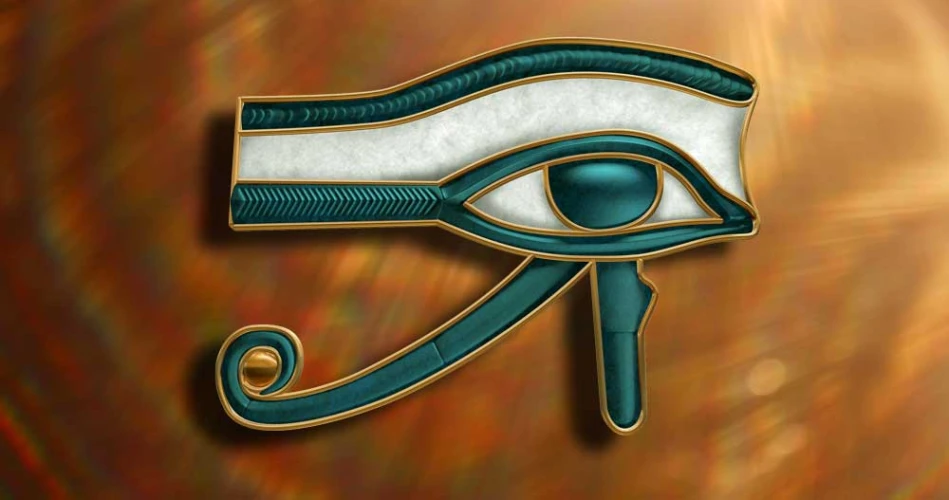
One more symbolic image that has tremendous visual and magical strength in ancient Egyptian mythology is the Eye of Horus, or the Wedjat.
The Story Behind the Symbol
It comes from the well-known confrontation between the gods Horus and his uncle Seth (the god of confusion and chaos). When Horus fought against Seth for his father, Osiris, he lost his left eye, which was then destroyed into many parts. Nevertheless, through the efforts of Thoth (god of magic and wisdom), the eye was restored and healed. So, the eye became the symbol of healing and restoring.
Magical Protection
The Eye of Horus is characterized by the fact that it has stylized elements of a falcon eye, including lines that represent tear marks or feathers of a falcon. This amulet had a great significance among Egyptians. It was worn by the living in order to protect oneself from jealousy, evil spirits, or sickness.
It also had a protective role when used on deceased people; these amulets would be placed inside the wrappings of a mummy.
3. The Sacred Scarab (Khepri)
Perhaps it seems somewhat strange in this age for the humble "beetle" to hold such a revered position, but for the ancient Egyptian, the scarab represented one of the greatest mysteries of creation: rebirth and metamorphosis.
The Importance of the Sun and Renewal
The ancient Egyptian witnessed the dung beetle dragging its ball of refuse around on the ground and burying it only to see new beetles emerge from it. From this, the ancient Egyptians drew an analogy to the movements of the sun and attributed this activity to a deity known as Khepri (the manifestation of the sun god at dawn). According to their beliefs, Khepri pushed the sun disk over the horizon each and every morning, as did the scarab beetle.
Heart Scarabs
Due to the connection between the scarab and rebirth, the beetle assumed great significance as a symbol of resurrection. A massive "Heart Scarab" was typically placed over the heart of the dead during the mummification process. Inscriptions taken from the "Book of the Dead" were carved upon it, asking the heart not to testify against him in the final judgment by Osiris.
4. The Djed Pillar
When analyzing symbols representing supreme strength, permanence, and endurance, one can say with confidence that the Djed Pillar takes a prominent place among them.
The Symbolism of Permanence
The symbol is shown as a pillar featuring a broad bottom and four stripes at the top. Most likely, it is used to describe the spine of Osiris, the ruler of the afterworld. This symbol signifies the following meanings:
Permanence and Steadfastness: An unshakeable force immune to all outside influences.
Renewal: The return from death into the world of the living and rising to his feet as the Lord Osiris has done.
In official rituals, there was one ceremony called "Raising the Djed Pillar" where the pharaoh would take the pillar from the ground with the help of ropes, which would mean the restoration of harmony, justice, and peace for the entire state.
5. The Knot of Isis (Tyet)
The Djed symbolizes the masculine strength of Osiris, while the Tyet, which is also referred to as the Knot of Isis or the Blood of Isis, symbolizes the feminine protection power of Isis, who is the wife of Osiris.
Shape and Symbolism
Similar to the Ankh symbol, the Tyet symbol consists of two curved lines folding downward as if representing tied cloth. Water and protection were also strongly related to the Tyet symbol since the object often contained life-giving water.
In most cases, the object was made from red stones such as jasper or carnelian, hence the term “Blood of Isis”. It acted as an amulet worn around the neck to protect the deceased from harm using the magic words of Isis when passing through the underworld.
6. The Lotus Flower (Sesen)
Aside from being representations of power and order, there was a very spiritual significance for the Egyptians when it came to nature. This was exemplified by the Lotus Flower, specifically the blue and white ones, which symbolized purity, creation, and the sun.
The lotus has a special natural process wherein the flower closes its petals each night and descends to the bottom of the dark, muddy water of the Nile to re-emerge on the surface of the water the next morning fully bloomed. This became an appropriate earthly representation of:
The Creation of the World – When the sun appeared out of the primordial water of chaos.
Rebirth – That after the darkness of death, life would once again blossom in the other world.
A depiction of the lotus flower can be seen all throughout Egyptian art – on the capitals of the enormous temple columns, perfume containers, and on the walls of funerary scenes.



-webp.webp "Hilton")
-webp.webp "dusit")
-webp.webp "Marriott Hotels")
-webp.webp "Azimut Hotel")
-webp.webp "Golden Tulip")
-webp.webp "sheraton")
-webp.webp "westin hotel")
-webp.webp "Movenpick")